Persians Erotic
Iran
Indo-European / Iranian / Persian
Islam / Shia Islam
Tat, along with significant populations in the United States, the United Arab Emirates, Canada, Germany, the United Kingdom, Bahrain, Australia, and Sweden
Central Asia
About Persians People
Persians are the people whose language, court culture, and self-conception have anchored the Iranian plateau for roughly two and a half millennia. The plateau itself shapes the story: a high, dry interior ringed by the Zagros and Alborz mountains, dotted with oasis cities — Isfahan, Shiraz, Yazd, Kerman — that grew up around qanats, the underground aqueducts that pull snowmelt out of the mountains and make agriculture possible in a country that is mostly desert. The cities, not the countryside, are where Persian identity has historically been forged.
The language is the through-line. Persian — Fārsi to its speakers — is an Indo-European language, a cousin of English and Hindi rather than a relative of the Arabic and Turkic tongues that surround it. It absorbed a heavy Arabic vocabulary after the seventh-century Islamic conquest but kept its grammar intact, and it then spent the next thousand years as the prestige literary language of a vast zone reaching from the Balkans to Bengal. Mughal emperors wrote in it. Ottoman poets imitated it. The poetry of Hafez, Saadi, Rumi, and Ferdowsi is not a national heirloom kept under glass; lines from it are quoted in ordinary conversation, at weddings, at funerals, in political speeches.
Religiously, Persians are overwhelmingly Twelver Shia, and have been since the Safavid dynasty made Shiism the state creed in 1501 — a deliberate political break from the Sunni Ottoman world to the west. Shia practice gives the calendar its rhythm: the mourning rituals of Muharram, the pilgrimages to Mashhad and Qom. Older layers persist underneath. Nowruz, the spring-equinox new year, is pre-Islamic Zoroastrian in origin and remains the most important holiday of the year, observed with more energy than any Islamic feast. Small Zoroastrian and Jewish communities still live in Yazd and Tehran, remnants of pre-conquest Iran.
The Tat, scattered across the Caucasus, speak a related Iranian language and are usually counted as a Persian sub-group, though many no longer identify that way. The larger demographic shift of the last half-century has been outward: the 1979 revolution and the Iran–Iraq war pushed a substantial educated diaspora to Los Angeles, Toronto, London, Dubai, and Sydney, and that diaspora has become a second, parallel Persian world — secular, often nostalgic, frequently in tension with the politics back home.
Typical Persians Phenotypes
Reference for AI generation — hair, eyes, skin, facial structure, build
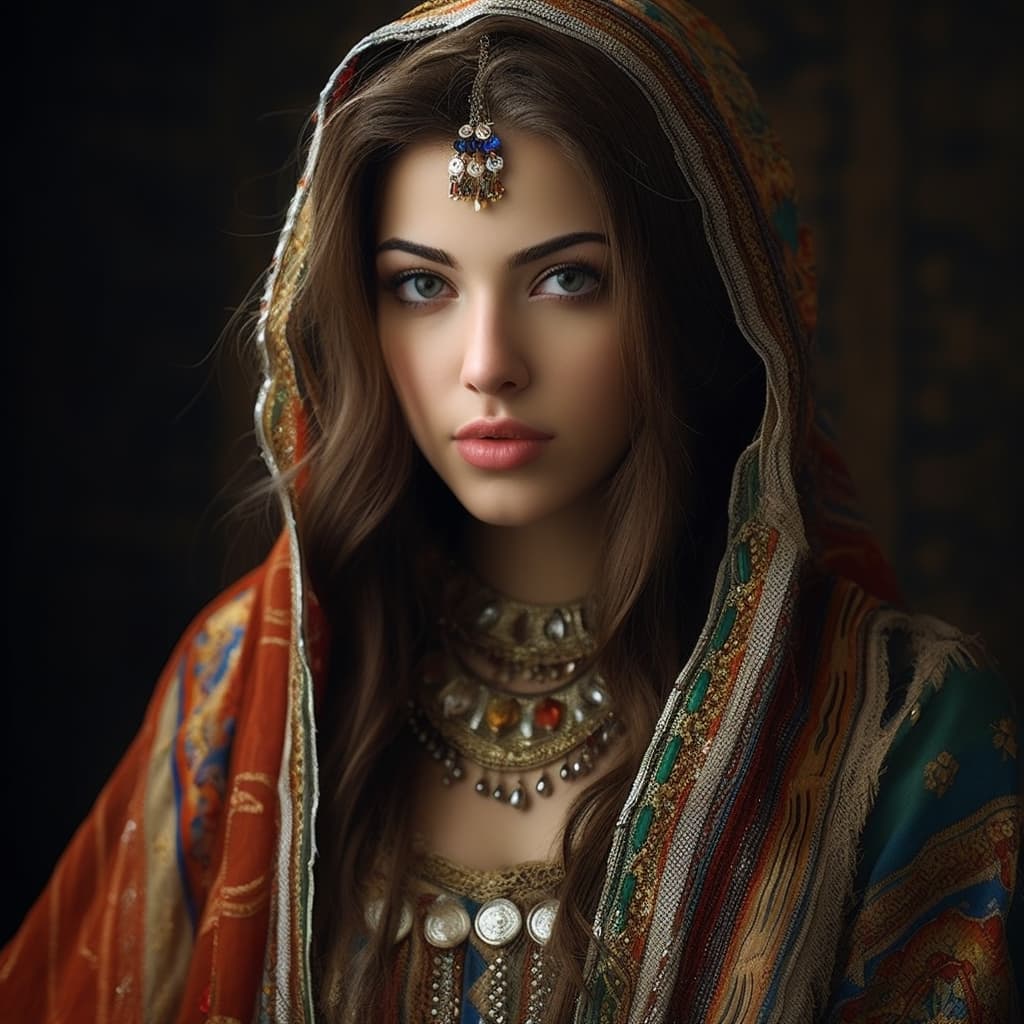
Persians sit at the genetic crossroads of the Iranian plateau — Indo-European populations with deep roots stretching from the Caspian to the Persian Gulf — and the phenotype reflects that range rather than any single template. The dominant impression is dark hair against medium-light to olive skin, with facial structure that tends toward defined, angular features: prominent noses, strong brow ridges, and well-architected cheekbones that read clearly even on softer faces.
Hair is overwhelmingly dark brown to black, typically thick and with natural body — straight to wavy is most common, with looser curl patterns appearing more often in southern and western populations. True black hair is less universal than the stereotype suggests; many Persians carry warm chestnut or coffee-brown tones that read black only in low light. Premature graying and silver streaks are notably common. Eye color follows the hair: dark brown predominates, but a meaningful minority — particularly in the northwest and among Caspian populations — carry hazel, green, or light brown, occasionally blue. Eyes are typically almond-shaped and deep-set under defined brows; no epicanthic fold.
Skin tone spans Fitzpatrick II through IV, centered on III — a warm olive with golden or yellow undertones rather than the pink undertones of European skin. Northern Iranians (Caspian, Azeri-adjacent regions) often run lighter; southern and Khuzestani Persians trend deeper, sometimes into Fitzpatrick V. The signature feature is the nose — a high, narrow bridge with a slight to pronounced convex curve and a refined tip, the classic "Persian profile" visible across figures as different as Shirin Ebadi and Reza Pahlavi. Lips are medium-full, often with a defined cupid's bow.
Build is medium — average male height around 5'8"–5'9", female around 5'4" — with a tendency toward proportional, hourglass or athletic frames rather than extremes. Body hair is typically dark and moderate to heavy on men. Among Tat and other northern subgroups, lighter coloring and finer features appear more frequently; southern and eastern Persians show stronger pigmentation and slightly broader facial proportions.
Data depth
72/100Coverage of image-grounded phenotype observations · drives AI generation diversity
- Sample size
- 40/40· 78 images
- Image quality
- 22/30· 44% high
- Confidence
- 10/20· mean 0.66
- Source diversity
- 0/10· wikipedia
- ·Wikipedia-only source — not population-representative
Observed Distribution — Image Sample
Empirical observations from analyzed photographs · supplementary signal, not population truth
Sample: 78 images analyzed (78 wikipedia). Quality: 34 high, 24 medium, 20 low, 0 very_low. Avg analyzer confidence: 0.65.
Skin tone (Fitzpatrick): II (12%), III (35%), IV (45%), unclear (9%)
Hair color: black (44%), gray/white (42%), dark brown (1%), red/auburn (1%), other (1%), unclear (10%)
Hair texture: straight (38%), wavy (27%), curly (5%), bald (4%), shaved (1%), covered (21%), unclear (4%)
Eye color: dark brown (73%), brown (3%), green (1%), blue (1%), other (1%), hazel (1%), unclear (19%)
Epicanthic fold: 0% present, 94% absent, 6% unclear
Caveats: Sample is 100% Wikipedia notable people — skews toward male, public-life, and modern figures, not population-representative.
Last aggregated: May 7, 2026
Explore phenotype categories
Structured taxonomy with peer-reviewed scales · 22 anatomical categories
Notable Persians People
100 reference figures — sourced from Wikipedia
- Ali Khamenei — former supreme leader of Iran (1989–2026)
- Ebrahim Raisi — former president of Iran (2021–2024)
- Hassan Rouhani — former president of Iran (2013–2021)
- Mahmoud Ahmadinejad — former president of Iran (2005–2013)
- Akbar Hashemi Rafsanjani — former president of Iran (1989–1997)
- Qasem Soleimani — former commander of the Quds Force (1998–2020)
- Ali Larijani — former Speaker of the Parliament of Iran (2008–2020)
- Mohammad Bagher Ghalibaf — former Mayor of Tehran, Speaker of the Islamic Consultative Assembly
- Ali Dizaei — senior officer in the London Metropolitan Police
- Anousheh Ansari — Iranian-American first female space tourist in the world, telecommunication e…
- Bahar Soomekh — Iranian-American actor
- Camila Batmanghelidjh — Iranian-Belgian founder of London-based children's charity Kids Company
- Reza Pahlavi — son of the deposed Shah of Iran, crown prince in exile.
- Shirin Ebadi — recipient of 2003 Nobel Peace Prize
- Akbar Ganji — journalist and writer
- Hossein Ronaghi — human rights activist
- Maryam Hashemi — Maryam Sandjari)
- Kia Joorabchian — businessman
- Hooman Radfar — entrepreneur
- Nasser David Khalili — billionaire and art collector
- Baba Ali — Islamic comedy
- Farzaneh Kaboli — folkloric
- Shahrokh Moshkin Ghalam — folkloric
- Nazanin Afshin-Jam — born 1979), actress, singer-songwriter, human-rights activist; Miss World 200…
- Ramona Amiri — Miss Canada 2005
- Sara Nicole Andersen — born 1992), Miss Universe Norway 2012
- Sahar Biniaz — born 1986), Miss Universe Canada 2012
- Aylar Lie — born 1984), Iranian-born Norwegian actress, model, singer, former pornographi…
- Apameh Schönauer — born 1984), Miss Germany 2024
- Shermine Shahrivar — born 1982), Miss Germany 2004, Miss Europe 2005
- Samantha Tajik — born 1983), Miss Universe Canada 2008
- Abbas Kiarostami — director of Taste of Cherry
- Asghar Farhadi — director of A Separation
- Bahman Ghobadi — director of A Time for Drunken Horses
- Desiree Akhavan — director of Appropriate Behavior
- Emud Mokhberi — Academy Award-nominated director and animator
- Jafar Panahi — director of The Circle
- Majid Majidi — director of Children of Heaven
- Mohsen Makhmalbaf — director of Kandahar
- Hossein Rajabian — director of The Upside-down Triangle
- Bob Yari — Iranian-born American film producer
- Pouran Derakhshandeh — award-winning film director and producer
- Samira Makhmalbaf — director of At Five in the Afternoon
- Loris Tjeknavorian — Loris Cheknavarian)
- Ali Movasat — DJ Aligator)
- Steve Naghavi — from And One
- Hangi Tavakoli — Multi-Platinum music producer and songwriter
- Amir Derakh — from the band Orgy
- Azadeh Ensha — The New York Times
- Farrokhi Yazdi — Pahlavi era
- Adel Ferdosipour — football announcer, Navad program
- Ali Akbar Abdolrashidi — correspondent, commentator, anchorman
- Mehrdad Kia — T.V. and Radio Broadcaster and executive producer in television and music ind…
- Alireza Jafarzadeh — Foreign Affairs Analyst, Fox News
- Christiane Amanpour — television journalist, CNN
- Fereydoun Farrokhzad — TV personality and opposition figure
- Jian Ghomeshi — musician, writer, and former CBC radio broadcaster
- Maryam Namazi — news anchor at Al Jazeera (English section)
- Reza Fazeli — actor, film director and opposition figure
- Rudi Bakhtiar — news anchor, formerly with CNN and Fox News
- Cyrus the Great — Iranian emperor and the founder of Iran
- Darius the Great — Iranian emperor
- Mithridates I of Parthia — Iranian emperor
- Ismail I — Iranian king
- Fazlollah Noori — conservative clergy opposing Constitutionalists; hanged
- Ghaem Magham Farahani — prime minister
- Hassan-e-Sabbah — sectarian political leader
- Kaveh the Blacksmith — mythical leader and liberator against the rule of Zahhak, an Arab king
- Mahmud Khan Puladeen — senior military general
- Mirza Kuchek Khan — constitutionalist leader of Guilan
- Mirza Mehdi Khan Astarabadi — Nader Shah's Chief Minister
- Mirza Reza Kermani — assassinated Nasereddin Shah
- Mohammad Khiabani — popular leader during Constitutionalist Revolution
- Mohammad Mossadegh — prime minister
- Mostowfi ol-Mamalek — prime minister
- Nosrat Dowleh Firouz Mirza — provincial governor
- Safi-ad-din Ardabili — spiritual founder of Safavid dynasty
- Sattar Khan — constitutionalist leader
- Heshmat Taleqani — Jangali leader and ally of Mirza Kuchek Khan
- Abdol Hossein Hamzavi — Iranian diplomat, author and representative to the United Nations
- Abdol Karim Ayadi — personal physician to Reza Pahlavi
- Ali Akbar Davar — minister, and founder of Iran's modern judiciary system
- Ali Akbar Siassi — Chancellor of Tehran University
- Ali Gholi Ardalan — Iranian ambassador to the US, West Germany and the USSR
- Amanullah Jahanbani — senior military leader, and father-in-law of Christiane Amanpour's father
- Amir Abdollah Tahmasebi — military leader
- Bahram Aryana — military commander
- Ahmad Ahmadi — prison interrogator
- Farokhroo Parsa — minister of education
- George Malek-Yonan — procured a seat in Iran's Parliament for Assyrians as a recognized minority
- Hasan Arfa — Army General, Ambassador to Russia, Ambassador to Turkey
- Hassan Modarres — member of Parliament
- Hassan Pakravan — head of SAVAK
- Heidar Arfaa — Conseiller d'État, Minister of Agriculture, Député-Majlis Fars province
- Hossein Fardoust — deputy head of SAVAK
- Hossein Fatemi — Minister of Foreign Affairs
- Hushang Ansary — Minister of Finance, President of NIOC
- Karim Buzarjomehri — Army General military aide of Reza Shah, Mayor of Tehran
- Mahmoud Jafarian — head of National Iranian Radio and Television and Pars News Agency
- Mahmoud Khayami — industrialist
Generate Persians AI Content
Use this ethnicity's phenotype data to create AI-generated content with accurate physical traits and cultural context.
Open Creator Studio