Pashtuns Erotic
Pashtunistan (Afghanistan, Pakistan)
Indo-European / Iranian / Pashto
Islam / Sunni Islam
Pashtun Americans, Kakar
Central Asia
About Pashtuns People
The Pashtuns are the people the world meets at the Khyber Pass — and then misreads. They number somewhere north of fifty million across a homeland that political maps cut in half: the Durand Line, drawn by a British official in 1893, runs straight through Pashtun country, leaving roughly a third of the population in Afghanistan and the larger share in Pakistan. They never agreed to that border, and in many practical senses they still don't recognize it. Families, tribal confederations, trade routes, and grazing patterns continue across it as if the line weren't there.
Pashto is an Eastern Iranian language, cousin to Persian but not mutually intelligible with it, and full of consonants — retroflex stops, a guttural kh — that sit awkwardly in neighboring Urdu and Dari mouths. The literary tradition runs deep: Khushal Khan Khattak in the seventeenth century wrote warrior poetry that is still quoted at funerals and weddings, and Rahman Baba's mystical verse is sung in shrines. Tribally the population is vast and segmentary — Durrani and Ghilzai are the two great confederations, with the Kakar prominent in Balochistan and many smaller branches threaded through the Suleiman range. A diaspora has formed over the last half-century in the Gulf, in Britain, and in North America, where Pashtun Americans are a small but visible community in cities like Northern Virginia and the Bay Area.
What outsiders most often miss is Pashtunwali, the unwritten code that governs honor, hospitality, refuge, revenge, and the standing of women. It is older than the conversion to Islam — which came mostly in the early medieval centuries and is now overwhelmingly Sunni of the Hanafi school — and the two systems coexist in a working compromise that mullahs and tribal elders renegotiate constantly. Melmastia, the obligation to shelter and feed any guest including an enemy, is the part travelers notice. Nanawatai, the right of asylum, has dragged Pashtun communities into geopolitics they didn't choose more than once. The jirga, an assembly of elders that decides disputes by consensus rather than vote, still settles cases that state courts cannot.
The twentieth and twenty-first centuries — Soviet invasion, civil war, Taliban movements drawn largely though not exclusively from Pashtun ranks, drone campaigns, mass displacement — have flattened how the group is depicted abroad. The interior life is less monolithic and considerably older than the headlines.
Typical Pashtuns Phenotypes
Reference for AI generation — hair, eyes, skin, facial structure, build
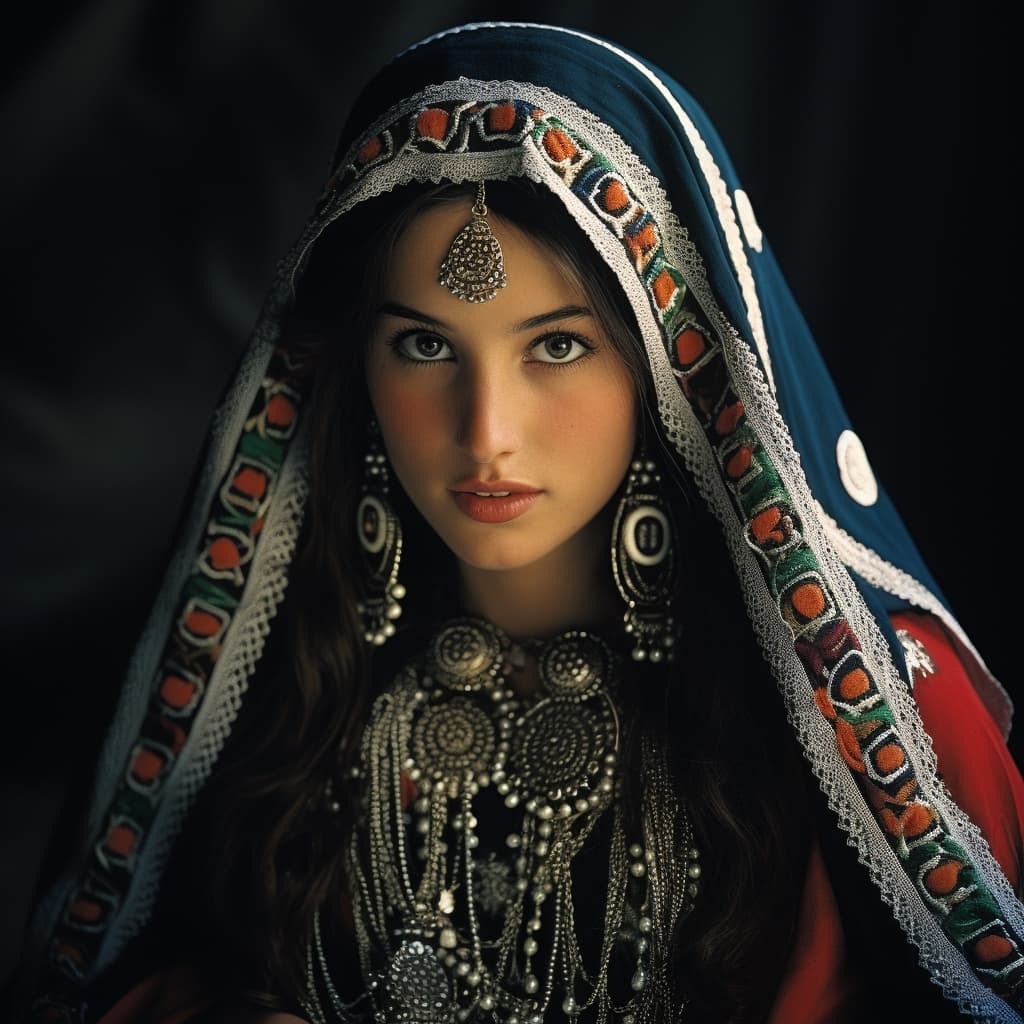
Pashtuns sit at a phenotypic crossroads — Iranian-plateau ancestry layered with Central Asian and South Asian inputs — and the result is a population whose features tend to read as sharper and more angular than neighboring groups. Hair is overwhelmingly dark brown to black, typically thick, with a wave pattern that runs from straight to loose curls; auburn and chestnut shades show up at meaningful frequency, particularly in the Ghilji and northern Yusufzai belts, and outright blond or red hair appears occasionally in children before darkening with age.
Eye color is where Pashtuns diverge most visibly from surrounding South Asian populations. Brown still dominates, but green, hazel, and pale blue occur at rates well above regional baseline — light eyes against deep olive skin is a recognizable Pashtun look, especially among Durrani, Yusufzai, and Afridi lineages. The eye shape is almond, deep-set, often with heavy upper lids and prominent brow ridges. The epicanthic fold is generally absent.
Skin tones span Fitzpatrick II through V, with the modal range sitting at olive to light wheat — warm undertones, often with a slight rosiness on the cheeks in lighter-skinned individuals. Sun exposure deepens the range considerably; rural Kakar and southern Pashtuns lean noticeably darker than urban or diaspora Pashtuns.
The facial architecture is the signature: long, narrow faces with high cheekbones, strong jawlines, and a high-bridged aquiline nose with a narrow alar base — the so-called "Pashtun nose" is real and statistically distinctive. Lips tend toward medium fullness, often with a defined cupid's bow. Beards grow thick and dense, frequently with reddish cast.
Build runs tall and lean by regional standards — average male stature sits around 173–175 cm, with broad shoulders and long limbs; the Kakar and Ghilji subgroups skew slightly heavier-set than the more gracile Yusufzai. Diaspora Pashtun Americans show the same skeletal template with broader weight variation. Ahmad Shah Durrani's portraiture captures the canonical phenotype well.
Data depth
0/100Coverage of image-grounded phenotype observations · drives AI generation diversity
- Sample size
- 0/40· 0 images
- Image quality
- 0/30· 0% high
- Confidence
- 0/20
- Source diversity
- 0/10
- ·No image observations yet
Explore phenotype categories
Structured taxonomy with peer-reviewed scales · 22 anatomical categories
Notable Pashtuns People
100 reference figures — sourced from Wikipedia
- Sultan Pakhal Swati — Founder of the Gibari Empire, also known as the Sultanate of Swat.
- Sultan Jehangir Khan Swati — Sultan of the Sultanate of Swat, ruling from Swat. Grandson of Sultan Pakhal.
- Jalal-ud-din Khilji — 1290–1296) – Founder of the Khilji dynasty.
- Alauddin Khilji — 1296–1316) – Famous for military campaigns and market reforms.
- Qutb-ud-din Mubarak Shah — 1316–1320) – Last ruler of the Khilji dynasty.
- Bahlul Lodi — founder of Lodi Dynasty (reigned 1451–1489), most powerful of the Pashtun chi…
- Sikandar Lodi — Sultan of Delhi
- Ibrahim Lodi — Sultan of Delhi Lodi Dynasty Reign 1517 – 21 April 1526
- Sher Shah Suri — Sultan of the Sur Empire Reign 17 May 1540 – 22 May 1545
- Adil Shah Suri — Last ruler of the Sur Dynasty
- Islam Shah Suri — Sultan of the Sur Empire Reign 27 May 1545 – 22 November 1554
- Firuz Shah Suri — Firuz Shah Suri
- Muhammad Adil Shah — Sultan of Hindustan
- Ibrahim Shah Suri — Sultan of the Sur Empire
- Sikandar Shah Suri — Sultan of the Sur Empire
- Abdur Rahman Khan — monarch of Afghanistan in the late 19th century
- Ahmad Shah Durrani — founding father of Afghanistan
- Shah Mahmud Hotaki — also known as the Conqueror, third Ruler of Hotak dynasty
- Abdul Aziz Hotak — second ruler of the Afghan Hotaki dynasty
- Malak Ahmad Khan Yusufzai — First ruler and founder of Modern-day Pashtunkhwa
- Gaju Khan Yousafzai — Pashtun revolutionary leader, ruled from Kunar to Taxila
- Wazir Akbar Khan — Emir of Afghanistan
- Jahan Khan — Commander-in-Chief of the Durrani Empire
- Amanullah Khan — Ghazi of the Third Anglo-Afghan War and King of Afghanistan from 1919 to 1929
- Amir Khan — Nawab of Tonk
- Ashraf Hotaki — Shah of Persia from 1725 to 1729 and fourth ruler of the Hotaki dynasty
- Ayub Shah — Afghan king
- Azim Khan — Barakzai noble and governor of Kashmir
- Azad Khan Afghan — Pashtun who was a major contender for supremacy in ruling Persia
- Daud Khan Panni — Mughal general
- Daud Khan Rohilla — a founder of Rohilkhand
- Daulat Khan Lodi — Governor of Lahore under the Lodi dynasty
- Dilir Khan Daudzai — 17th century Mughal general
- Dost Mohammad of Bhopal — Nawab of Bhopal
- Dost Mohammad Khan — monarch of Afghanistan in the 19th century
- Habibullah Khan — King/Emir of Afghanistan
- Haibat Khan Niazi — Commander of Niazi contingent of Sher Shah Suri's army and Governor of Punjab
- Hafiz Rahmat Khan Barech — Rohilla Chieftain
- Hamid Khan Lodi — founder of Lodi dynasty of Multan after the end of Arab rule in 961 A.D
- Hamidullah Khan — last Nawab of former Bhopal state in India
- Hussain Hotak — last ruler of the Hotaki dynasty at Kandahār
- Inayatullah Khan — Afghan king
- Isa Khan Niazi — Masnad-e-Aali in reign of Sher Shah Suri shafqat zaman
- Khawas Khan Marwat — general of Sher Shah Suri
- Khushal Khan Khattak — Warrior-Poet and Chief of the Khattak tribe of Pashtuns
- Malik Akora Khattak — Great grandfather of Khushal Khan Khattak and Chief of Khattak tribe
- Mahmud Hotak — Shah of Persia from 1722 to 1725 and third ruler of the Hotak Dynasty
- Mahmud Shah Durrani — monarch of Afghanistan in the 18th century
- Mirwais Hotak — founder of the Afghan Hotak dynasty in Kandahār
- Mohammad Akbar Khan — Afghan prince and warrior
- Mohammad Ayub Khan — Afghan Royal Prince and Emir of Afghanistan, fondly remembered as the Victor …
- Muhammad Habib Khan Tarin — Nawab, chieftain and cavalry officer
- Muhammad Khan Bangash — founder of Farrukhabad state in the early 18th century
- Mohammad Nadir Shah — King of Afghanistan from 1929 to 1933
- Mohammad Yaqub Khan — monarch of Afghanistan in the late 19th century
- Mohammed Zahir Shah — last king of Afghanistan, reigned for 40 years
- Muhammad Mahabat Khan III — last Nawab of Junagarh (defunct title)
- Najabat Khan — Pashtun Nawab and renowned warrior
- Najib Khan Yousafzai — Afghan Rohilla Nawab instrumental in the Afghan victory at Panipat III, infli…
- Nasrullah Khan — Shahzada Crown Prince of Afghanistan
- Nawab Muzaffar Khan — Durrani Nawab of Multan
- Shah Shujah Durrani — Sadozai) – former king of Afghanistan
- Timur Shah Durrani — monarch of Afghanistan, second ruler of the Durrani Empire
- Zabita Khan — Rohilla chieftain
- Zain Khan Sirhindi — Durrani general
- Zaman Shah Durrani — monarch of Afghanistan
- Khwaja Usman — Pashtun Chieftain warrior of Bengal
- Hakim Khan Sur — Army General of Maharana Pratap in Battle of Haldighati
- Kalu Khan Yousafzai — Afghan warrior and military leader in 16th Century who inflicted one of the g…
- Sartor Faqir — Pashtun tribal Yusufzai leader and freedom fighter; declared a jihad against …
- Mullah Omar — Founder of Taliban
- Farhad Darya — Afghanistan) – Afghan singer and composer, known for his contributions to Afg…
- Ahmad Zahir — Afghanistan) – Pashtun singer and composer, known for his brilliant musical t…
- Abdul Ghani Khan — Pakistan/Afghanistan) – Pashto poet, writer, philosopher, and artist
- Ameer Hamza Shinwari — Pakistan/Afghanistan) - Pashto Poet, Writer, philosopher etc
- Sardar Ali Takkar — Pakistan/Afghanistan) – popular sufist Pashto singer.
- Rahim Shah — Pakistan) – popular Pashto and Urdu singer
- Khyal Muhammad — Pakistan) – prominent Pashto folk singer
- Gulzar Alam — Afghanistan/Pakistan) – Pashto singer and music composer
- Gul Panra — Pakistan) – Urdu-Pashto female singer
- Zeb Bangash — Pakistan) – Urdu-Pashto folk singer
- Zeek Afridi — Pakistan) – Urdu-Pashto folk singer
- Badar Munir — Pakistan) – Pashto Film former actor
- Kushhal Khan — Pakistan) – Pashto model and actor
- M Huncho — Afghan-British) – Afghan-British rapper and singer from London.
- Imran Ahmed — political strategist and CEO of the Center for Countering Digital Hate
- Kabir Stori — Pashtun nationalist writer and poet who founded and served as chairman of the…
- Khushal Khattak — Pashtun poet, tribal chief, warrior and the national poet of Afghanistan
- Abdul Hai Habibi — prominent Afghan historian and a member of the National Assembly of Afghanistan
- Abdul Rauf Benawa — writer, poet, journalist, historian, and social activist of Afghanistan.
- Abdul Shakoor Rashad — prominent researcher, professor of Pashto language, and author of several books.
- Khan Abdul Ghani Khan — Pashto poet, philosopher, and writer
- Hamza Shinwari — Pashto poet and writer known for his romantic poetry
- Ajmal Khattak — Pashto poet, writer, and politician
- Rahman Baba — Pashto poet and Sufi saint
- Abaseen Yousafzai — Pashto poet known for his modernist poetry
- Hafiz Alpuri — Pashto Poet
- Khatir Afridi — Pashto poet and writer
- Malala Yousafzai — Pashto writer, activist, and Nobel Peace Prize laureate
- Sri M, born Mumtaz Ali Khan — Author, Educationist, Spiritual Guide, Yogi of Nath tradition, founder of Sat…
Generate Pashtuns AI Content
Use this ethnicity's phenotype data to create AI-generated content with accurate physical traits and cultural context.
Open Creator Studio