Mien Erotic
China (Hunan, Guizhou), Vietnam
Hmong–Mien / Mienic
Yao folk religion
Iu Mien, Kim Mun, Dzao Min, Biao Min, Bunu, Lakkia, Biao Mon
East Asia
About Mien People
The Mien — better known in the broader literature as Yao, though Mien is what most of them call themselves — are a mountain people whose center of gravity sits in the broken upland country of southern China, with substantial communities that drifted south over the last few centuries into northern Vietnam, Laos, and Thailand. They are not one tidy ethnos but a cluster of related branches: Iu Mien, Kim Mun, Dzao Min, Biao Min, Bunu, Lakkia, Biao Mon. Some of these speak languages mutually intelligible only with effort; a Bunu speaker and an Iu Mien speaker, dropped into the same room, would mostly be guessing. What links them is a shared origin story, a shared writing tradition, and an unusually durable ritual culture.
Their language sits in the Hmong–Mien family, a small but tenacious branch of East Asian languages that is genuinely its own thing — not Sino-Tibetan, not Tai, not Austroasiatic, despite centuries of close contact with all three. Mien speakers borrowed enormous quantities of vocabulary from Chinese, particularly the literary and ritual register, but the grammatical bones of the language are unrelated. One consequence of that long Chinese contact is that the Mien are among the very few non-Han peoples in southern China to have used Chinese characters as their own liturgical script, copying ritual manuscripts by hand across generations. A village priest's chest of hand-bound texts is still, in some communities, the most valuable object in the household.
The religion most often labeled Yao folk religion is really a Daoist–ancestral synthesis, absorbed from Chinese popular Daoism somewhere around the Song dynasty and then localized so thoroughly that it now feels indigenous. Ordination ceremonies — long, expensive, requiring the participation of older priests and the slaughter of pigs — confer ritual authority and a posthumous name; an unordained man is, in the cosmological sense, incomplete. The pantheon is enormous, the painted scrolls hung during ceremonies are striking, and the ritual specialists genuinely know what they are doing.
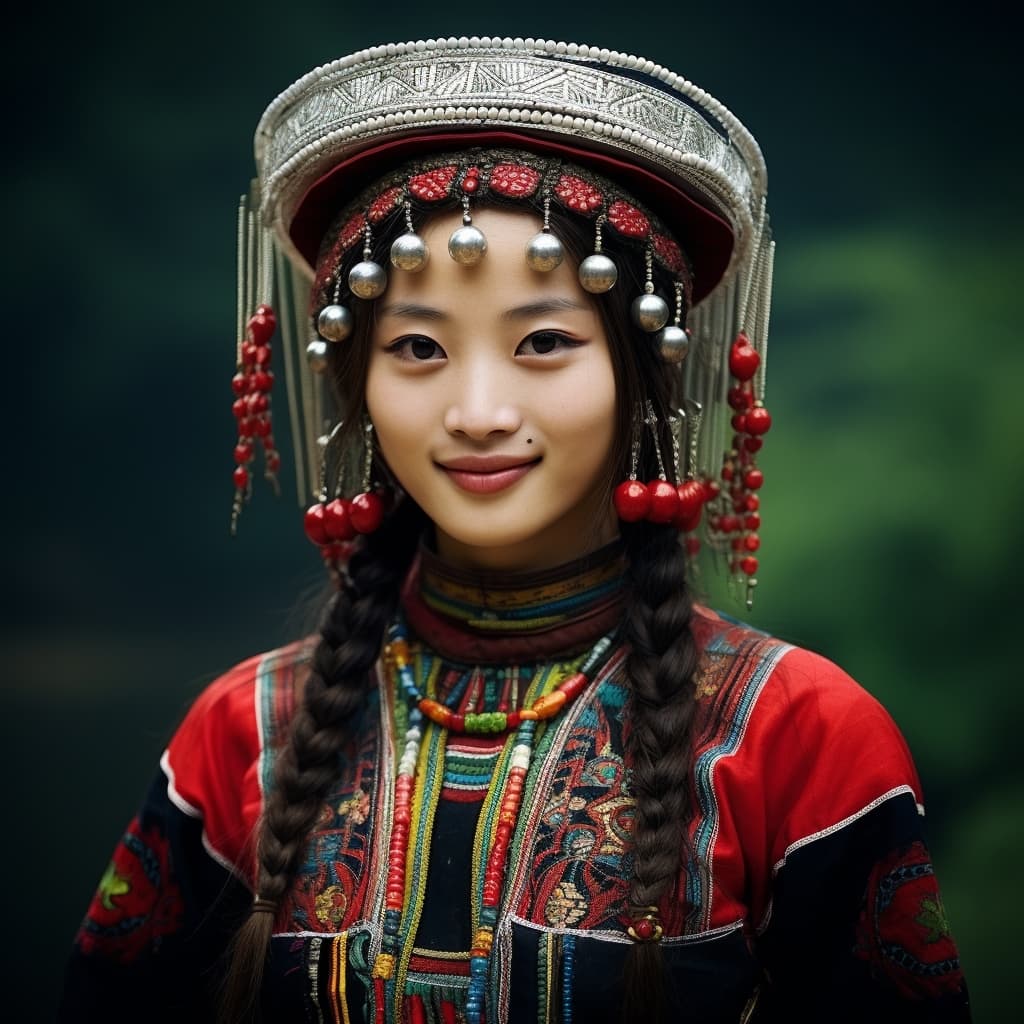
Historically the Mien have moved a great deal, often under pressure: pushed off better land by Han expansion, then again by the upheavals of the twentieth century. The Iu Mien diaspora in the United States, concentrated in California and Oregon, is largely a legacy of CIA recruitment in Laos during the Vietnam War and the refugee resettlement that followed. Embroidery — dense red and white geometry on indigo cloth, worked into trousers and headcloths — remains one of the clearest visual markers of Mien identity wherever the community has landed.
Typical Mien Phenotypes
Reference for AI generation — hair, eyes, skin, facial structure, build
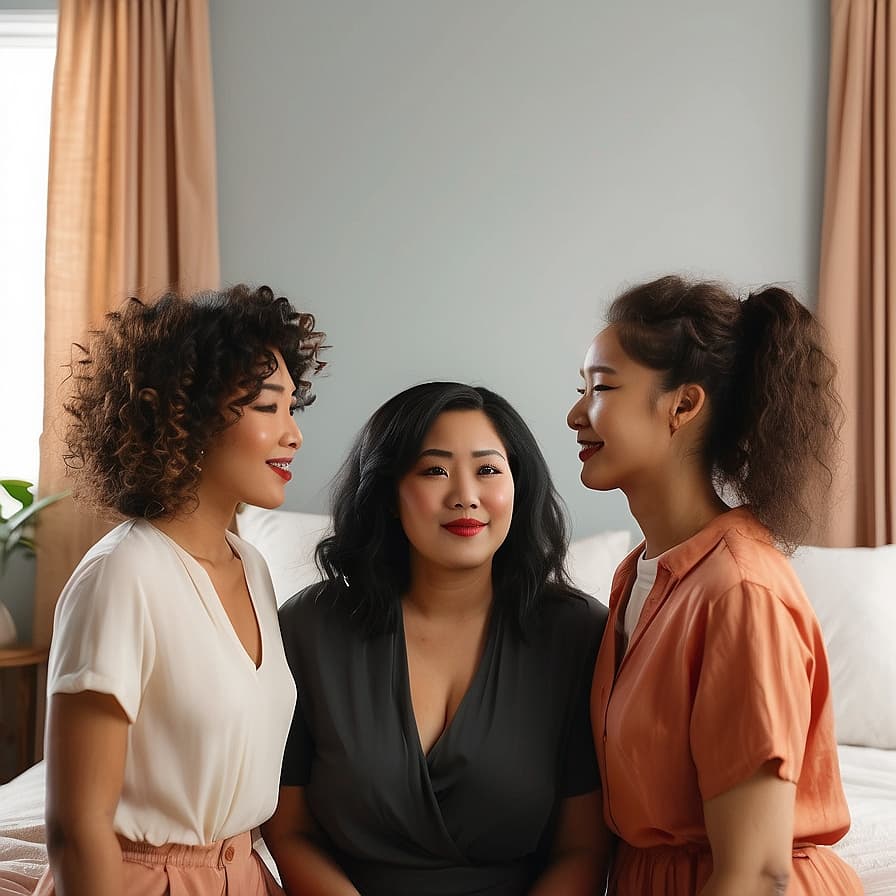
The Mien (Yao) sit within the broader East Asian phenotype but carry distinctive features that set them apart from Han neighbors — most notably a more rounded, softer facial geometry and a stockier, shorter-statured build shaped by generations in the mountainous terrain of southern China and the Indochinese highlands. Hair is uniformly black or near-black, straight to faintly wavy, coarse in texture, and slow to gray; the coarse density is often visible in traditional images of women with floor-length uncut hair coiled under the characteristic red turban. Premature graying is uncommon. Eyes are dark brown to near-black, with a near-universal epicanthic fold and a single-fold (monolid) upper eyelid being the dominant pattern, though a low double crease appears in a meaningful minority. Eye shape tends toward almond with a moderate upward outer canthal tilt.
Skin runs Fitzpatrick III to IV, leaning toward a warm yellow-olive undertone rather than the cooler ivory common in northern Han populations. Highland sun exposure produces noticeably tanned, ruddier complexions in agricultural sub-groups, while urban Iu Mien diaspora skin tends lighter. The face is typically round to oval with full, flat cheeks, a relatively low and broad nasal bridge, moderate alar width, and a short philtrum. Lips are medium in fullness — neither thin nor pronounced — and the jaw is soft and rounded rather than angular. Brow ridges are flat.
Build is compact: adult women average roughly 150–155 cm, men 160–165 cm, with short limbs relative to torso and a tendency toward solid, muscular legs from terrace farming. Body fat distribution favors the midsection in middle age. Among sub-groups, the Iu Mien and Kim Mun show the broadest, roundest facial structure; the Lakkia and Biao Min trend slightly taller and narrower-faced; the Bunu, more genetically intermixed with neighboring Zhuang, often display a longer face and higher nasal bridge than the Mienic core.
Data depth
13/100Coverage of image-grounded phenotype observations · drives AI generation diversity
- Sample size
- 3/40· 1 image
- Image quality
- 0/30· 0% high
- Confidence
- 10/20· mean 0.55
- Source diversity
- 0/10· wikipedia
- ·No image observations yet
- ·Wikipedia-only source — not population-representative
Explore phenotype categories
Structured taxonomy with peer-reviewed scales · 22 anatomical categories
Notable Mien People
3 reference figures — sourced from Wikipedia
- Hongzhi Emperor — of the Ming dynasty (1470-1520), had a Yao mother
- Lei Yingchuan — 1957-1979), soldier
- Wang Yungui — born 1992), entrepreneur and businesswoman

Generate Mien AI Content
Use this ethnicity's phenotype data to create AI-generated content with accurate physical traits and cultural context.
Open Creator Studio