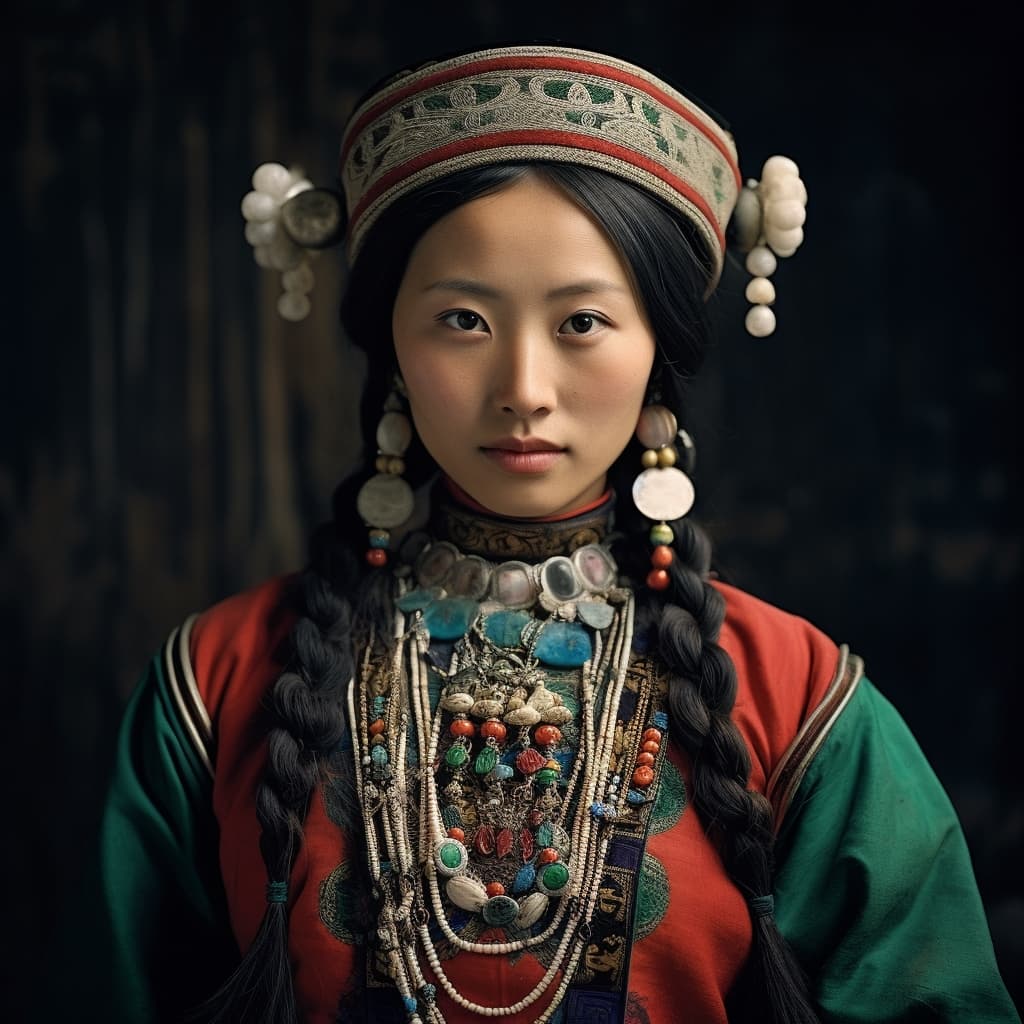
Manchu Erotic
Manchuria
Tungusic / Manchu[
Shamanism
East Asia
About Manchu People
The Manchu are the people who, in 1644, walked through a gate that a Ming general opened for them and ended up ruling China for nearly three centuries. That fact tends to swallow everything else about them, but it's the wrong place to start. Before the Qing dynasty, before the banner system, before they were called Manchu at all, they were Jurchen — a confederation of forest and river peoples in the northeast, hunting sable, raising horses, fishing the Sungari and Amur. The name "Manchu" was a political act: Hong Taiji declared it in 1635 to bind the tribes into a single nation suitable for conquest. It worked.
Their homeland — what foreigners call Manchuria and what the Chinese state now calls the Northeast — is a cold, flat-bottomed country of black soil, larch forest, and long winters, hemmed in by the Greater Khingan range to the west and the Korean peninsula to the south. The Manchu language belongs to the Tungusic family, distantly related to Evenki and Nanai, and unrelated to Chinese in any structural sense. It is a vowel-harmonizing, agglutinating language written in a vertical script adapted from Mongolian, which itself was adapted from Uyghur. For two centuries it was a court language with a vast translation bureaucracy behind it. Today it has perhaps a few dozen first-language speakers left, almost all elderly, in villages along the Heilongjiang border. Recovery efforts exist; nobody pretends the trajectory is good.
Manchu religion was — and where it survives, still is — shamanic, organized around clan shamans who mediated between the living and the spirits of ancestors, animals, and place. The Qing emperors, even at their most Confucianized, kept a shaman's altar in the Forbidden City and continued sacrificing pigs to ancestral spirits in a small wooden pavilion behind the throne hall. Buddhism and Chinese folk religion layered on top over the centuries, but the shamanic substrate never fully dissolved.
What makes the Manchu unusual among conquest peoples is that they assimilated so thoroughly into the population they ruled that, by the 20th century, most of their roughly ten million descendants spoke only Mandarin and were culturally indistinguishable from Han neighbors. The category survived; the distinctiveness mostly didn't. Sub-groups like the Xibe, resettled to Xinjiang in the 1760s as a garrison, ended up preserving the old language better than the heartland did — a quiet historical irony.
Typical Manchu Phenotypes
Reference for AI generation — hair, eyes, skin, facial structure, build
The Manchu phenotype reads as a recognizable variant of Northeast Asian morphology, distinct from Han Chinese in ways that were more pronounced before three centuries of intermarriage softened the contrast. The classical Manchu look — still visible in rural Heilongjiang and Jilin populations and preserved in Qing-era portraiture — runs taller, broader-faced, and lighter-skinned than the Han average to the south.
Hair is uniformly black to very dark brown, coarse in texture, and overwhelmingly straight with high density. Premature graying is uncommon. Eye color sits in the dark brown range, occasionally lightening to a warmer russet brown in older individuals. The epicanthic fold is near-universal but tends to be lighter and less pronounced than in southern Han or Korean populations, and the single-lid (monolid) and low-crease double-lid forms are both common. Eye shape is typically elongated and slightly upswept, with a relatively narrow palpebral fissure.
Skin tone is pale — Fitzpatrick II to III — with cool to neutral undertones and a tendency to flush red rather than tan under cold-weather sun exposure. The famously fair complexion of Qing imperial women was not artistic license; it tracks the population baseline.
Facial structure is the most distinctive feature. Manchu faces tend to be broad and flat across the malar plane, with high, wide-set cheekbones and a relatively short midface. The nose is medium in projection with a straight or slightly low bridge and moderate alar width — broader than Korean, narrower than Mongolian. Lips are medium in fullness. Jaws are squared in men, more tapered in women, with a tendency toward a strong mandibular angle.
Build is taller than the Han mean, with documented average heights closer to Northern Mongolian and Korean ranges — historically a horse-and-archery culture, and the skeletal proportions reflect it. Limbs are proportionally long, shoulders broad, and body composition runs lean-muscular in younger adults, with a tendency toward central weight gain with age. Sub-group variation is now driven more by degree of Han admixture than by historical clan lineage, with the most archetypal phenotype concentrated in northeastern rural counties and Xibe-related populations in Xinjiang.
Data depth
0/100Coverage of image-grounded phenotype observations · drives AI generation diversity
- Sample size
- 0/40· 0 images
- Image quality
- 0/30· 0% high
- Confidence
- 0/20
- Source diversity
- 0/10
- ·No image observations yet
Explore phenotype categories
Structured taxonomy with peer-reviewed scales · 22 anatomical categories

Generate Manchu AI Content
Use this ethnicity's phenotype data to create AI-generated content with accurate physical traits and cultural context.
Open Creator Studio