Lurs Erotic
Iran (Lorestan, Kohgiluyeh and Boyer-Ahmad, Khuzestan, Bushehr, and Chaharmahal and Bakhtiari Provinces)
Indo-European / Iranian / Luri
Islam / Shia Islam
Bakhtiari, Iranian Laks
Central Asia
About Lurs People
The Lurs are a people of the Zagros — the long mountain spine that runs down western Iran, dividing the Mesopotamian plain from the Iranian plateau. Their territory is vertical country: oak forests, snowmelt rivers, high pastures in summer and sheltered valleys in winter. For most of recorded history the Lurs were transhumant pastoralists, moving their flocks between elevations on schedules older than the states that tried to tax them, and that rhythm still shapes how Lur identity is talked about, even by Lurs who have lived in Tehran or Ahvaz for two generations.
Luri is an Iranian language, close enough to Persian that outsiders sometimes call it a dialect and Lurs reliably push back. It sits in its own branch alongside Persian and Kurdish, with several internal varieties — Luri proper in Lorestan, Bakhtiari in the central Zagros, and Laki to the north, which some linguists group with Kurdish instead. The Bakhtiari are the largest and most politically visible of the Lur sub-groups; their khans were major players in late Qajar and early Pahlavi Iran, and the 1909 march on Tehran that helped restore the constitution was led in large part by Bakhtiari horsemen. The Laks, smaller and more northern, occupy a contested middle ground where Lur and Kurdish identity blur into each other and people answer the question depending on who is asking.
Lurs are overwhelmingly Twelver Shia, like most Iranians, but the religion sits on top of an older substrate of saint shrines, sacred trees, and oath-customs tied to specific mountains and springs. Tribal affiliation — the tayefeh and the smaller lineage groups within it — has historically mattered as much as sect, and disputes were settled by councils of elders and codified honor norms long before, and often instead of, state courts. The 20th century was hard on this structure. Reza Shah's forced sedentarization in the 1920s and 30s broke the seasonal migration for many clans; later land reforms and the draw of oil-economy cities did the rest. What survives is a strong sense of distinctness: a music of double-reed sorna and frame drums at weddings, a still-living oral poetry, woven goat-hair tents that get pitched on summer pastures more out of preference than necessity, and a pride in being Zagros people that doesn't need to be explained to anyone who is one.
Typical Lurs Phenotypes
Reference for AI generation — hair, eyes, skin, facial structure, build
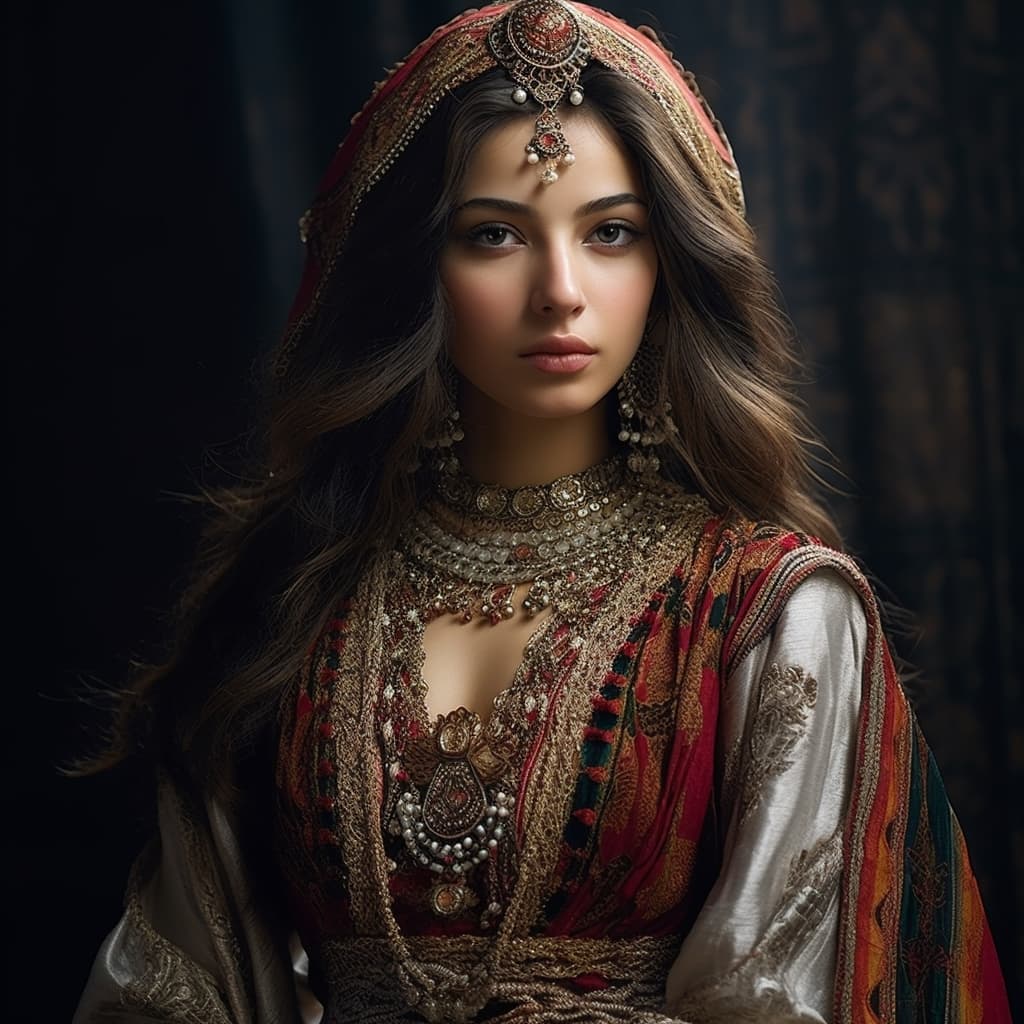
The Lurs sit at the phenotypic crossroads of the Zagros highlands — closer in build and feature to neighboring Kurds and Bakhtiari than to lowland Persians of the central plateau, with a strong substrate of indigenous Iranic ancestry going back to the Elamites and pre-Median populations of southwestern Iran. The defining impression is a relatively robust, weathered mountain phenotype: medium-tall with broad shoulders, strong jawlines, and high color in the cheeks from generations of pastoral life at altitude.
Hair runs dark — black through dark brown predominate, with chestnut and lighter brown showing in a meaningful minority, especially among Bakhtiari from the higher valleys. Texture is typically thick and wavy, occasionally tightly curled; straight hair is the exception. Beard growth is heavy and starts early in men, often graying to a distinguished iron rather than white. Eye color is overwhelmingly brown to dark brown, but green and hazel surface more often than in southern Iran — the Bakhtiari in particular carry a noticeable rate of light eyes, and pure blue does appear, if rarely. The eye shape is wide-set and almond, set under heavy, often joined brows; the epicanthic fold is absent.
Skin tone clusters in Fitzpatrick III–IV: a warm olive to light wheat base with golden or faintly red undertones, tanning deeply and evenly with sun exposure rather than burning. Faces are angular and structured — straight or gently aquiline noses with a defined bridge and moderate alar width, prominent cheekbones, and squared jaws. Lips are medium in fullness, neither thin nor pronounced. The overall facial geometry reads as sharper and more vertically long than the rounder Persian average.
Build tendencies favor wiry strength: lean, broad-chested frames in men, a stocky-athletic norm rather than slender, with men averaging roughly 170–175 cm. Bakhtiari tend to be the tallest and most likely to carry lighter pigmentation; Laks read slightly darker on average, with somewhat heavier facial features. Qadam Kheyr's surviving photographs show the archetype well — strong cheekbones, a long straight nose, and the unmistakable Zagros gaze.
Data depth
0/100Coverage of image-grounded phenotype observations · drives AI generation diversity
- Sample size
- 0/40· 0 images
- Image quality
- 0/30· 0% high
- Confidence
- 0/20
- Source diversity
- 0/10
- ·No image observations yet
Explore phenotype categories
Structured taxonomy with peer-reviewed scales · 22 anatomical categories
Notable Lurs People
7 reference figures — sourced from Wikipedia
- Qasem Soleimani — was an Iranian military officer who served in the Islamic Revolutionary Guard…
- Ahmed Lur — He was one of the disciples of Fazlallah Na'imi, the founder of the Hurufism …
- Bahlul Mahi — Baba Lura, a Yarsani poet, saint, reincarnation of Pir Benyamin, and close di…
- Qadam Kheyr — was a notable Luri woman of the late Qajar period.
- Shahmirza Moradi — was an Iranian Lur especially versed in playing sorna.
- Bibi Maryam Bakhtiari — was a revolutionary and activist of the Iranian Constitutional Revolution.
- Rais-Ali Delvary — was an Iranian Lur military leader.






Generate Lurs AI Content
Use this ethnicity's phenotype data to create AI-generated content with accurate physical traits and cultural context.
Open Creator Studio