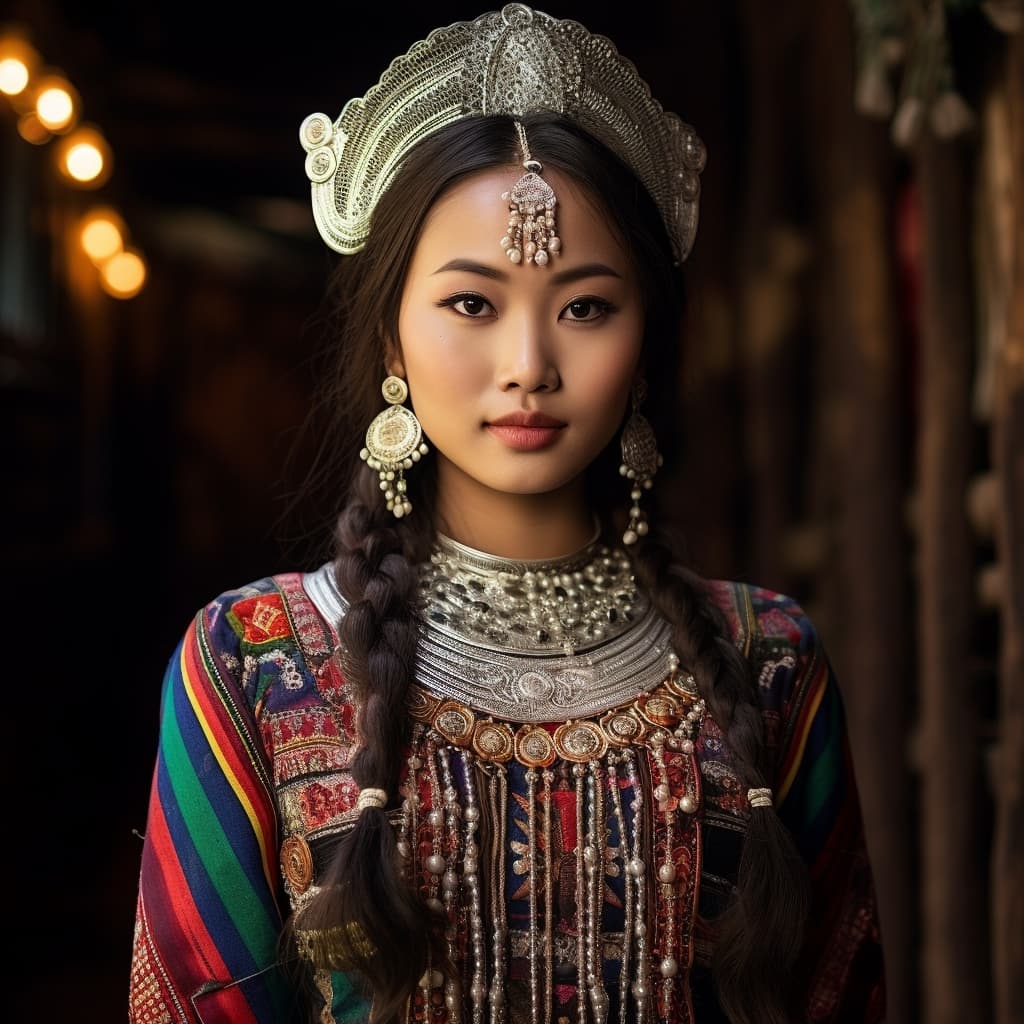
Lisu Erotic
China, Myanmar
Sino-Tibetan / Loloish / Lisu
Christianity / Protestantism
Lipo
East Asia
About Lisu People
The Lisu live along the steep, river-cut grain of the eastern Himalayan foothills — the Salween, Mekong, and upper Irrawaddy gorges where Yunnan, Myanmar, and the borderlands of Tibet and northern Thailand meet. Their villages sit high on the slopes rather than down in the valleys, a settlement pattern that reflects both a preference for the cooler highland belt and centuries of accommodating more powerful lowland neighbors. They are a Tibeto-Burman people within the Loloish branch — closely related to the Yi, Lahu, and Akha — and the Lipo, sometimes treated as a separate group and sometimes as a Lisu sub-group, are linguistically and culturally the nearest of these cousins.
The language is tonal and was unwritten until the early twentieth century, when a British missionary, James O. Fraser, working with Lisu and Karen collaborators, devised a script using rotated Latin capitals — the so-called Fraser alphabet, still the dominant orthography today. That script's history is inseparable from the other thing that distinguishes the Lisu among upland peoples of the region: most Lisu communities, particularly in Myanmar and northwestern Yunnan, are Protestant Christian, and have been for roughly a century. Conversion was not incidental; it reorganized village life around the church, replaced certain shamanic practices, and gave the Lisu a literate religious culture in their own language at a moment when that was rare for highland minorities. Pockets of older animist and ancestor-focused practice persist, and in parts of Yunnan a Buddhist or syncretic overlay is more visible, but the Christian center of gravity is real and shapes everything from hymn-singing traditions to modern diaspora networks.
Daily Lisu life has historically turned on swidden agriculture — buckwheat, maize, dry rice — supplemented by hunting, which the Lisu were known for; the crossbow remains a cultural emblem more than a working tool. Women's clothing varies sharply by region and sub-group, but the long pleated skirts, turbans, and heavy strings of beads associated with the Black, White, and Flowery Lisu reflect older self-distinctions the Lisu draw among themselves, not a single uniform. The Kuomintang–era and Cold War upheavals of the Burma frontier scattered Lisu communities further south into Thailand, where they are recognized as one of the official hill tribes, and a smaller diaspora has settled in the West, often through church-linked migration channels that trace directly back to those early-century missions.
Typical Lisu Phenotypes
Reference for AI generation — hair, eyes, skin, facial structure, build
The Lisu phenotype reads as a Tibeto-Burman highland variant — recognizably East Asian in core structure, but with the slightly leaner facial geometry and warmer skin undertones common to the upland Loloish-speaking peoples of the Yunnan–Myanmar–northern Thailand frontier. They are not a Han-type phenotype, and Lisu themselves draw the distinction sharply.
Hair is uniformly black to very dark brown, straight to faintly wavy, with the heavy single-strand thickness typical of East Asian populations. Premature greying is uncommon before middle age. Eyes run dark brown to near-black; epicanthic folds are near-universal but tend toward the softer, less pronounced form seen across Tibeto-Burman highlanders rather than the tighter monolid common further north. Eye shape is moderately almond, set under relatively flat brow ridges.
Skin tone sits in the Fitzpatrick III–IV range, with warm golden to light olive undertones — generally a shade or two deeper than lowland Han averages, reflecting both ancestry and the sun exposure of mountain agricultural life. Tans readily, rarely burns severely. Facial structure shows medium-to-high cheekbones, a relatively narrow face by East Asian standards, a nose with a low-to-medium bridge and moderate alar width (broader than Han, narrower than mainland Southeast Asian averages), and lips of medium fullness. Jawlines tend to be tapered rather than square.
Build is compact and wiry. Stature runs short — adult men typically 160–168 cm, women 150–157 cm — with low body-fat tendencies and lean muscle distribution shaped by terrace farming and steep terrain. Shoulders are narrow to moderate; limbs are proportionally long for the torso. Footballer Anon Amornlerdsak sits at the taller, more athletically built end of the range rather than the median.
The Lipo branch, concentrated in Yunnan, is essentially indistinguishable from core Lisu in appearance, though some observers note slightly rounder facial contours and a marginally lighter average skin tone in the eastern Lipo populations closer to Han contact zones.
Data depth
0/100Coverage of image-grounded phenotype observations · drives AI generation diversity
- Sample size
- 0/40· 0 images
- Image quality
- 0/30· 0% high
- Confidence
- 0/20
- Source diversity
- 0/10
- ·No image observations yet
Explore phenotype categories
Structured taxonomy with peer-reviewed scales · 22 anatomical categories
Notable Lisu People
2 reference figures — sourced from Wikipedia
- Anon Amornlerdsak — Thai football player
- J Yaw Wu — Burmese politician

Generate Lisu AI Content
Use this ethnicity's phenotype data to create AI-generated content with accurate physical traits and cultural context.
Open Creator Studio