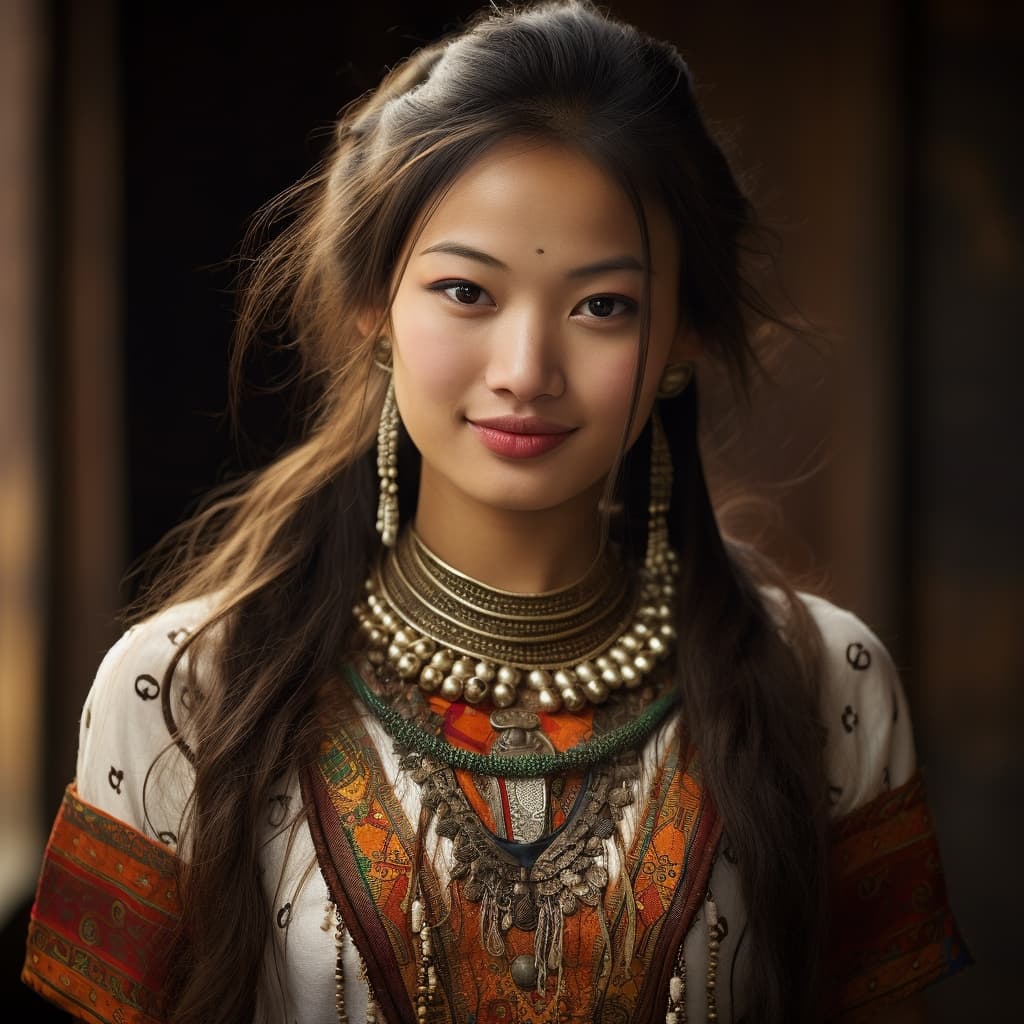
Lhoba Erotic
Tibet (Arunachal Pradesh
Adi, Bokar, Idu Mishmi
Animism, Buddhism
Nishi, Na, Galo, Mishmi people, Tagin, Adi
Central Asia
About Lhoba People
The Lhoba are the people of the forested ridges where the eastern Himalayas drop into the Brahmaputra basin — a sliver of land that India administers as Arunachal Pradesh and China claims as part of southern Tibet. The name itself is a Tibetan exonym, applied loosely from the north to a cluster of communities the Lhasa court historically regarded as outsiders to the plateau. What gets bundled under "Lhoba" is in practice several distinct peoples: the Adi along the middle Siang, the Galo and Tagin to the west, the Nishi further still, and the Idu, Digaru and Miju Mishmi in the deep valleys closer to the Burmese frontier. They share a frontier and a landscape more than they share an identity.
Their languages reflect that. Most fall within the Tani branch of Sino-Tibetan — Adi, Galo, Bokar, Tagin — closely related enough that neighboring valleys can usually understand one another with effort, while Idu and the other Mishmi tongues sit further out and are notoriously difficult to classify. Tibetan is spoken at the northern edge by Lhoba groups inside the TAR; Assamese and English carry across the Indian side. There is no single Lhoba literary tradition, and writing systems are recent imports.
Religion runs along the same grain. The dominant inheritance is animist — Donyi-Polo, the cult of Sun and Moon, is the formalized version that Adi and Galo communities have rallied around in recent decades, partly as a deliberate counterweight to Christian missionary pressure from the south and Tibetan Buddhist influence from the north. Mishmi groups maintain their own shamanic specialists, the igu, who conduct elaborate funerary rites that can stretch over days. Buddhist practice exists where Tibetan contact has been close, but it sits on top of the older substrate rather than replacing it.
Historically the Lhoba lived outside the reach of any state. Lhasa taxed them lightly and intermittently; the British Raj never seriously administered the hills above the Brahmaputra; the McMahon Line drawn in 1914 cut through their territory on a map they had no part in. The 1962 Sino-Indian War turned that line into a hard border, and families on either side were severed. Today the Indian-administered groups are recognized as Scheduled Tribes with their own state; the much smaller Chinese-side population is counted as one of the PRC's official 56 nationalities. Weaving, cane-and-bamboo architecture, and patrilineal clan structure remain everyday features rather than heritage performances.
Typical Lhoba Phenotypes
Reference for AI generation — hair, eyes, skin, facial structure, build
The Lhoba — the umbrella term China uses for the Adi, Nishi, Galo, Mishmi, Tagin, Na, and related communities straddling the Tibet–Arunachal Pradesh border — sit at a phenotypic crossroads where Tibeto-Burman highland features meet the more Southeast-Asian-leaning populations of the eastern Himalayan foothills. The result is a group that reads visibly East Asian in bone structure but with darker skin and softer eye morphology than ethnic Tibetans further north.
Hair is uniformly black or near-black, coarse, and straight to lightly wavy; graying tends to come late. True curl is essentially absent. Eyes range from dark brown to near-black, almost always set with an epicanthic fold, though the fold is often shallower and the palpebral fissure slightly wider and less upslanted than in Tibetans or Han populations — a Mishmi or Adi face often looks more open-eyed than a Lhasa face. Double eyelids appear at moderate frequency, especially among the Adi and Galo.
Skin spans Fitzpatrick III to V, centered on a warm light-to-medium brown with golden or olive undertones; Mishmi groups from the lower, wetter valleys tend to sit a shade darker than Adi and Nishi from higher elevations. Cheekbones are broad and high, typical of the Tibeto-Burman base, but faces are generally rounder and less angular than the long Tibetan face. Noses are short to medium with a low-to-moderate bridge and moderate alar width — broader than Han Chinese, narrower than mainland Southeast Asian averages. Lips are medium-full, the lower lip often noticeably fuller than the upper.
Build is compact and wiry. Men typically fall in the 158–168 cm range, women 148–158 cm, with the dense, well-muscled legs that come from generations of steep-terrain agriculture and hunting. Shoulders are squared but not broad; torsos are short relative to limb length. Mishmi populations tend slightly taller and darker; Nishi and Adi tend lighter-skinned and more classically East-Asian-featured, with Tagin and Na sitting between the two poles.
Data depth
0/100Coverage of image-grounded phenotype observations · drives AI generation diversity
- Sample size
- 0/40· 0 images
- Image quality
- 0/30· 0% high
- Confidence
- 0/20
- Source diversity
- 0/10
- ·No image observations yet
Explore phenotype categories
Structured taxonomy with peer-reviewed scales · 22 anatomical categories






Generate Lhoba AI Content
Use this ethnicity's phenotype data to create AI-generated content with accurate physical traits and cultural context.
Open Creator Studio