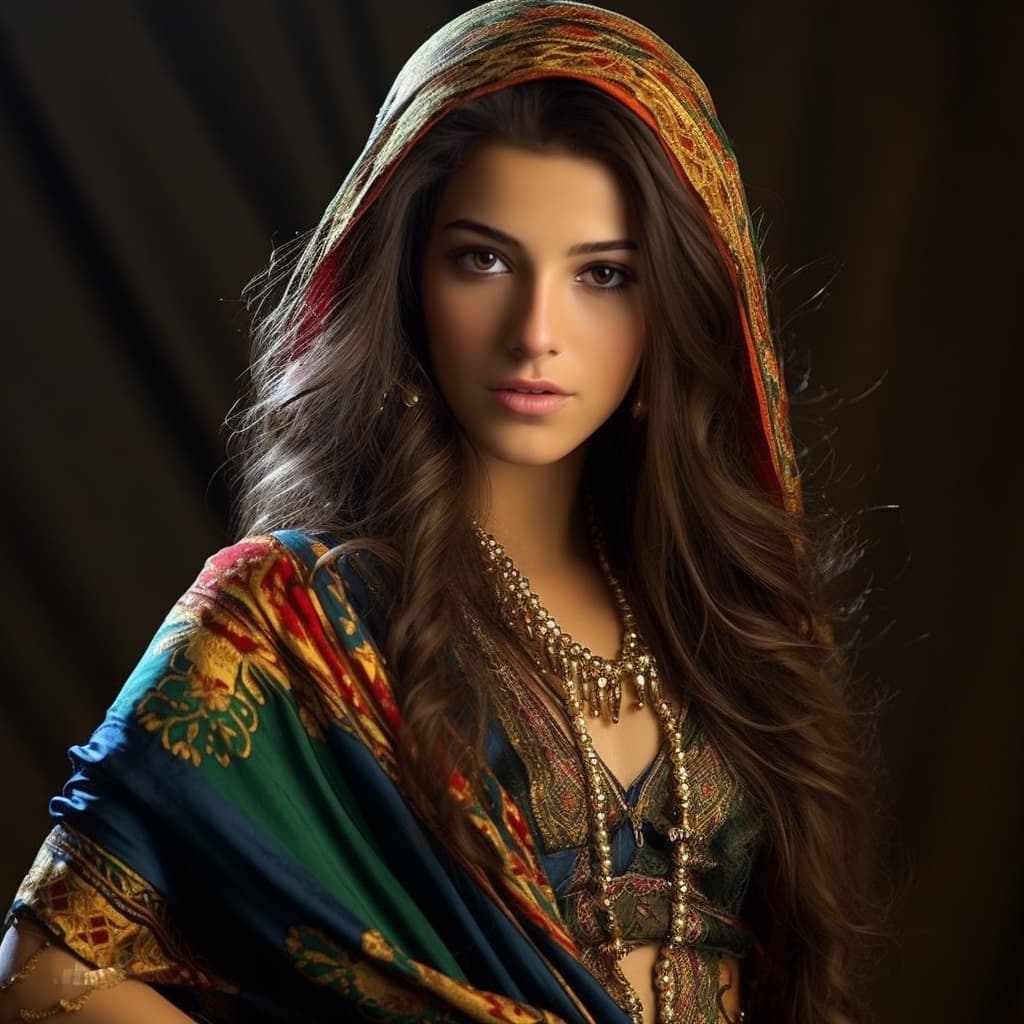
Kurds Erotic
Kurdistan (Turkey, Iran, Iraq, Syria)
Indo-European / Iranian / Kurdish
Islam / Sunni Islam
Bajalan, Kurmanjis, Sorans, Zazas, Feylis, Iranian Laks, Yazidis, Shabak, along with significant populations in France and Germany
Western Asia
About Kurds People
The Kurds are the largest stateless people in the world — somewhere between thirty and forty-five million speakers of related Iranian languages, scattered across the mountain belt where Turkey, Iran, Iraq, and Syria meet. The borders cut through the homeland; the homeland predates the borders. That fact shapes nearly everything else about Kurdish life, from the politics of the diaspora in Berlin and Marseille to the way a village in Hakkari handles a wedding invitation from cousins on the wrong side of a checkpoint.
Kurdish is not a single language so much as a cluster. Kurmanji, spoken across Turkey and Syria and into the Caucasus, is the largest branch and is written in a Latin alphabet adapted in the twentieth century. Sorani, dominant in Iraqi Kurdistan and western Iran, uses a modified Arabic script and has functioned as the de facto literary standard there since the 1920s. Zazaki and Gorani — still classed as Kurdish by most speakers, though linguists argue — sit further out on the Iranian family tree, closer in some respects to the languages of the Caspian coast than to Kurmanji itself. A Kurd from Diyarbakır and one from Sulaymaniyah can struggle to follow each other without effort.
Most Kurds are Sunni Muslims of the Shafi'i school, which sets them apart from the Hanafi Turks and Arabs around them and gives Kurdish religious life a slightly different texture — Sufi orders, particularly the Naqshbandi and Qadiri, have historically carried real social weight and produced several of the great political families. But the religious map is more varied than the headline suggests. The Feylis of the Iran–Iraq borderlands are largely Twelver Shia. The Yazidis, concentrated around Sinjar and Lalish in northern Iraq, follow a syncretic faith whose roots reach back well before Islam and who have endured repeated attempts at extermination, most recently and brutally in 2014. The Shabak and the small Bajalan and Kakai communities each carry their own heterodox traditions, often kept quiet.
The twentieth century delivered serial catastrophe — the partition of Ottoman territory without a Kurdish state, the suppressions in republican Turkey, the Anfal campaign and the gassing of Halabja in 1988, the more recent wars across northern Syria. Newroz, the spring new year on 21 March, is celebrated everywhere Kurds live and has become as much a political assertion as a seasonal one: bonfires on hillsides, in city parks, and in exile.
Typical Kurds Phenotypes
Reference for AI generation — hair, eyes, skin, facial structure, build
Kurds present a distinctly West Asian highland phenotype shaped by long isolation in the Zagros and Taurus mountain belts. Hair is overwhelmingly dark — black to deep brown dominates, with chestnut and dark auburn appearing more often among Kurmanji and Zaza populations of southeastern Turkey than further south. Texture runs straight to loosely wavy, with tighter wave and curl common among Sorani and Feyli Kurds of Iraq and western Iran. Body and facial hair growth is heavy in men; thick, well-defined eyebrows that nearly meet across the bridge are a recognizable trait across the group.
Eyes are typically dark brown to near-black, but the Kurdish population carries one of the highest rates of light eyes in the Middle East — green, hazel, and gray-blue surface regularly, especially in northern and Yazidi communities. The eyelid is open and almond-shaped with no epicanthic fold; the orbit sits deep under a pronounced brow ridge.
Skin tones span Fitzpatrick III to IV, with warm olive and wheat undertones most common. Northern Kurmanji and Zaza Kurds trend lighter, often Fitzpatrick II–III with cool olive cast; Feyli and southern Sorani Kurds run toward Fitzpatrick IV with deeper tan undertones. Sun exposure in agricultural and pastoral regions deepens the complexion considerably.
Facial structure is the group's most consistent marker: a high, often convex nasal bridge with a narrow-to-medium alar base, sometimes dropping into a slight downward tip. Cheekbones are high and broad, jaws square in men and tapered in women, with medium-full lips. The "Kurdish nose" — strong, aquiline, structurally prominent — is the single feature most often used to identify the phenotype.
Build skews mesomorphic and sturdy rather than tall, with average male stature around 170–173 cm. Mountain populations show robust shoulder and chest development; Yazidi communities, historically endogamous, preserve a slightly more uniform look — lighter eyes, finer features, paler skin — than the broader Kurdish range.
Data depth
23/100Coverage of image-grounded phenotype observations · drives AI generation diversity
- Sample size
- 17/40· 8 images
- Image quality
- 6/30· 13% high
- Confidence
- 0/20· mean 0.09
- Source diversity
- 0/10· wikipedia
- ·Small sample (n<10)
- ·Low overall confidence
- ·Mostly low-quality source images
- ·Wikipedia-only source — not population-representative
Observed Distribution — Image Sample
Empirical observations from analyzed photographs · supplementary signal, not population truth
Sample: 8 images analyzed (8 wikipedia). Quality: 1 high, 1 medium, 5 low, 1 very_low. Avg analyzer confidence: 0.09.
Skin tone (Fitzpatrick): unclear (100%)
Hair color: blonde (13%), other (13%), black (13%), unclear (63%)
Hair texture: wavy (25%), covered (50%), unclear (25%)
Eye color: unclear (100%)
Epicanthic fold: 0% present, 25% absent, 75% unclear
Caveats: Sample size 8 is small — observed distribution should be treated as suggestive, not definitive. Quality skews toward older or low-resolution photos; phenotype detail may be lossy. Low average analyzer confidence — many photos partially obscured or historical. Sample is 100% Wikipedia notable people — skews toward male, public-life, and modern figures, not population-representative.
Last aggregated: May 7, 2026
Explore phenotype categories
Structured taxonomy with peer-reviewed scales · 22 anatomical categories
Notable Kurds People
100 reference figures — sourced from Wikipedia
- Jaban al-Kurdi — 6th century)
- Bahlool Mahi — 9th century)[citation needed]
- Mir Jafar Dasni — d. c. 841)
- Muhammad ibn Husayn al-Rawadi — d. c. 953–956)
- Daysam ibn Ibrahim al-Kurdi — d. c. 957)
- Evdilsemedê Babek — 972–1019)
- Al-Mawardi — 974-1058)
- Badr ibn Hasanwayh — r. 979–1013)
- Abu Hanifa Dinawari — 9th-century)
- Abu Nasr Husayn II — r. 1001–1025)
- Ali Hariri — 1009–1079/80)
- Abu’l-Fatḥ Moḥammad b. ʿAnnāz — d. 1010/1)[citation needed]
- Zahir ibn Hilal ibn Badr — r. 1013–1015)
- Hilal ibn Badr — r. 1014)
- Fadluya — r. 1030–1078)
- Fadl ibn Muhammad — d. 1031)
- Abu'l-Fath Musa — r. 1031–1034)
- Lashkari ibn Musa — r. 1034–1049)
- Abu Nasr Mamlan II — r. 1058/9–1070)
- Abu Mansur Wahsudan — d. 1059)
- Abu'l-Aswar Shavur ibn Fadl — d. 1067)
- Anushirvan ibn Lashkari — d. c. 1067)
- Ashot ibn Shavur — r. 1068–1069)
- Manuchihr ibn Shavur — r. 1072–1118)
- Fadl ibn Shavur — d. 1073)
- Fadlun ibn Fadl — r. 1073–1075)
- Badh ibn Dustak — d. 1093/6)
- Fakhr-un-Nisa — 11th century)
- Firuz-Shah Zarrin-Kolah — 11th century)
- Ibn al-Azraq al-Fariqi — 1116–1176)
- Abu'l-Aswar Shavur ibn Manuchihr — r. 1118–1124)
- Fadl ibn Shavur ibn Manuchihr — r. 1125–1130)
- Fakr al-Din Shaddad ibn Mahmud — r. 1131–1155)
- Saladin — 1137–1193)
- Al-Adil I — 1145–1218)
- Fadl ibn Mahmud — r. 1155–1161)
- Sayf al-Din al-Amidi — 1156–1233)
- Shahanshah ibn Mahmud — r. 1164–1174)
- Al-Afdal ibn Salah ad-Din — c. 1169–1225)
- Shirkuh — d. 1169)[citation needed]
- Az-Zahir Ghazi — 1172–1216)[citation needed]
- Najm ad-Din Ayyub — d. 1173)[citation needed]
- Sultan ibn Mahmud — r. 1174–1199)
- Al-Ashraf Musa — 1178–1237)
- Al-Mu'azzam Isa — 1176–1227)
- Al-Kamil — 1117–1238)
- Turan-Shah — d. 1180)
- Ibn al-Salah — 1181–1245)
- Al-Mu'azzam Turanshah ibn Salah al-Din — c. 1181 – 1260)
- Bahramshah — r. 1182–1230)
- Farrukh Shah — d. 1182)
- Muhammad ibn Shirkuh — d. 1186)
- Al-Mansur Nasir al-Din Muhammad — 1189– c. 1216)
- Al-Muzaffar I Umar — d. 1191)
- Tughtakin ibn Ayyub — d. 1197)
- Al-Aziz Uthman — d. 1198)
- Al-Mansur I Muhammad — 12th century)
- Fakhraddin — 12th century)
- Izz al-Din Usama — 12th century)
- Masud ibn Namdar — 12th century)
- Mehmed Reshan — 12th century)
- Nasirdin — 12th century)
- Sejadin — 12th century)
- Al-Awhad Ayyub — d. 1210)
- Al-Adil II — 1221–1248)
- An-Nasir Yusuf — 1228–1260)
- Al-Mujahid — d. 1240)
- As-Salih Ayyub — 1205–1249)
- An-Nasir Dawud — 1206–1261)
- Al-Aziz Muhammad — c. 1213–1236)
- Sitt al-Sham — d. 1220)
- Al-Ashraf Musa, Emir of Homs — 1229–1263)
- Dayfa Khatun — d. 1242)
- As-Salih Ismail — d. 1245)
- Al-Mansur Ibrahim — d. 1246)
- Al-Muzaffar Ghazi — d. 1247)
- Ibn al-Hadjib — d. 1249)
- Al-Ashraf Musa, Sultan of Egypt — r. 1250–1254)
- Al-Muazzam Turanshah — d. 1250)
- Fakhr al-Din al-Akhlati — d. 1260)
- Safi-ad-din Ardabili — 1252/3–1334)
- Abulfeda — 1273–1332)
- Al-Kamil Muhammad — d. 1260)
- Shabankara'i — 1298–1358)
- Al-Shahrazuri — 13th century)
- Amadin — 13th century)
- Husam al-Din Chalabi — 13th century)
- Khatuna Fekhra — 13th century)
- Saʿd al-Din al-Humaidi — 13th century)
- Sheikh Mand — 13th century)
- Sheikh Obekr — 13th century)
- Sadr al-Din Musa — 1305–1391)
- Zain al-Din al-'Iraqi — 1325–1404)
- Nusrat al-Din Ahmad — d. 1330)
- Al-Afdal Muhammad — d. 1341)
- Mele Perîşan — 1356–1431)
- Sayyid Husayn Ahlati — d. 1397)
- Mela Huseynê Bateyî — 1417–1495)
- Izz al-Din Shir — d. 1423)
- Khvajeh Ali Safavi — d. 1427)






Generate Kurds AI Content
Use this ethnicity's phenotype data to create AI-generated content with accurate physical traits and cultural context.
Open Creator Studio