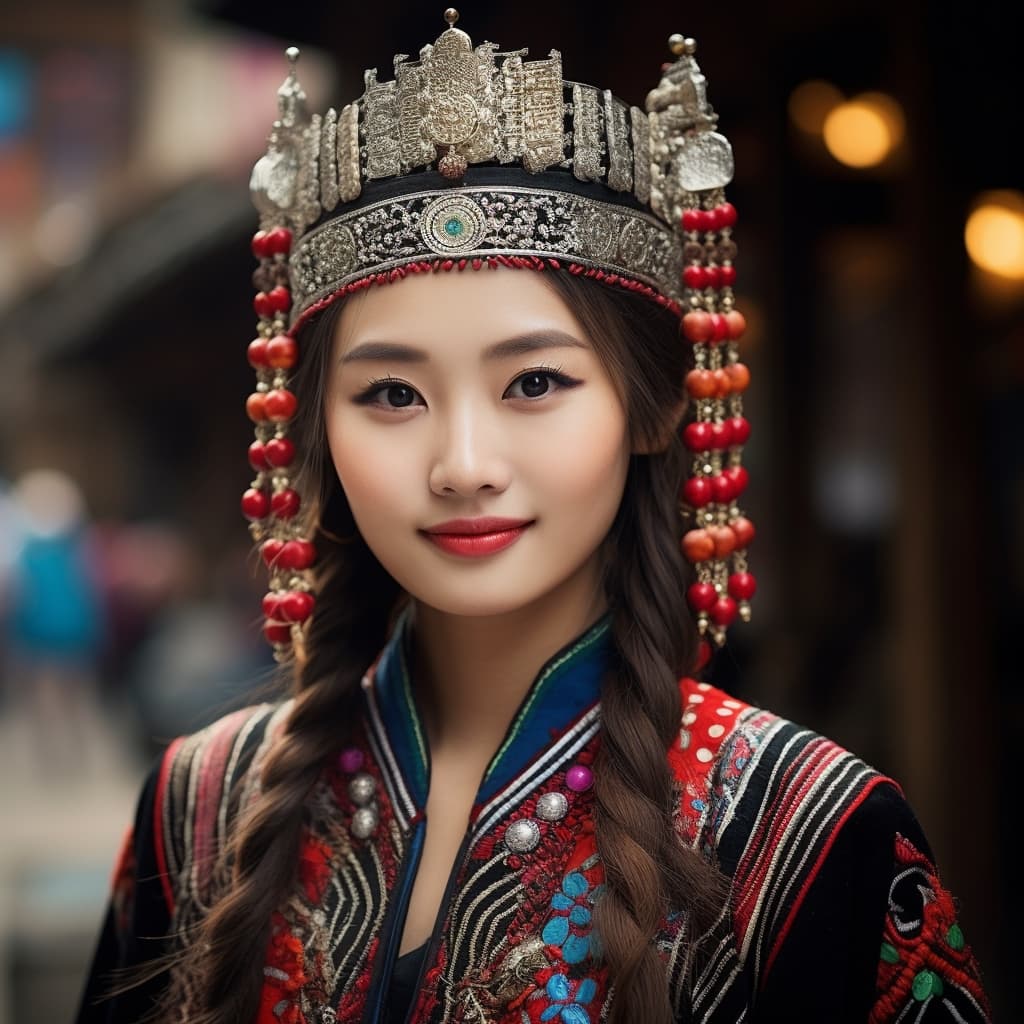
Hmong Erotic
Guizhou (China)
Hmong–Mien / Hmongic
Hmong folk religion
A-Hmao, Gha-Mu, Xong, Pa-Hng, Hmong Americans
East Asia
About Hmong People
The Hmong are a mountain people whose identity has been shaped less by any single homeland than by the long habit of moving between ridges and reorganizing under pressure. Their core territory runs through the karst highlands of Guizhou and the surrounding provinces of southwest China, but Hmong communities also live across northern Vietnam, Laos, Thailand, and Myanmar, and — since the late 1970s — in significant diaspora pockets in the United States, France, and French Guiana. The branches Chinese ethnographers call Miao subdivide further into clusters the Hmong themselves recognize by dialect and dress: A-Hmao, Gha-Mu, Xong, Pa-Hng, and others, each with distinct embroidery vocabularies and song traditions. The Hmong Americans, descendants of CIA-allied fighters from the Secret War in Laos, are themselves now several generations deep and have produced their own literary and musical scenes.
The language belongs to the Hmong–Mien family, a small and isolated group with no demonstrated relationship to Chinese, Tibetan, or the Tai languages spoken in the same valleys. It is heavily tonal — most varieties carry seven or eight contrastive tones — and was historically unwritten. Several scripts now compete: the Romanized Popular Alphabet developed by missionaries in 1950s Laos, the indigenous Pahawh Hmong invented by the messianic figure Shong Lue Yang in 1959, and various Chinese-developed orthographies. Religion among non-Christian Hmong centers on a household-based animism in which ancestors, household spirits, and the souls of the living all require maintenance. The shaman, or txiv neeb, conducts soul-calling ceremonies and negotiates with the spirit world on behalf of the sick; the practice survived collectivization in China and resettlement in the West, and is still actively performed in Minnesota and Wisconsin living rooms.
Two cultural particulars are worth knowing. First, Hmong New Year — timed to the end of the rice harvest rather than a fixed calendar date — features the pov pob ball-toss, a courtship game in which lines of young men and women face off and pair up by catching and dropping a cloth ball. Second, the paj ntaub, the reverse-appliqué textile work done by Hmong women, served during the Laotian refugee years as a narrative medium: story cloths embroidered in camps along the Thai border depicted village life, the war, and the river crossings, and now hang in museums as primary historical documents.
Typical Hmong Phenotypes
Reference for AI generation — hair, eyes, skin, facial structure, build
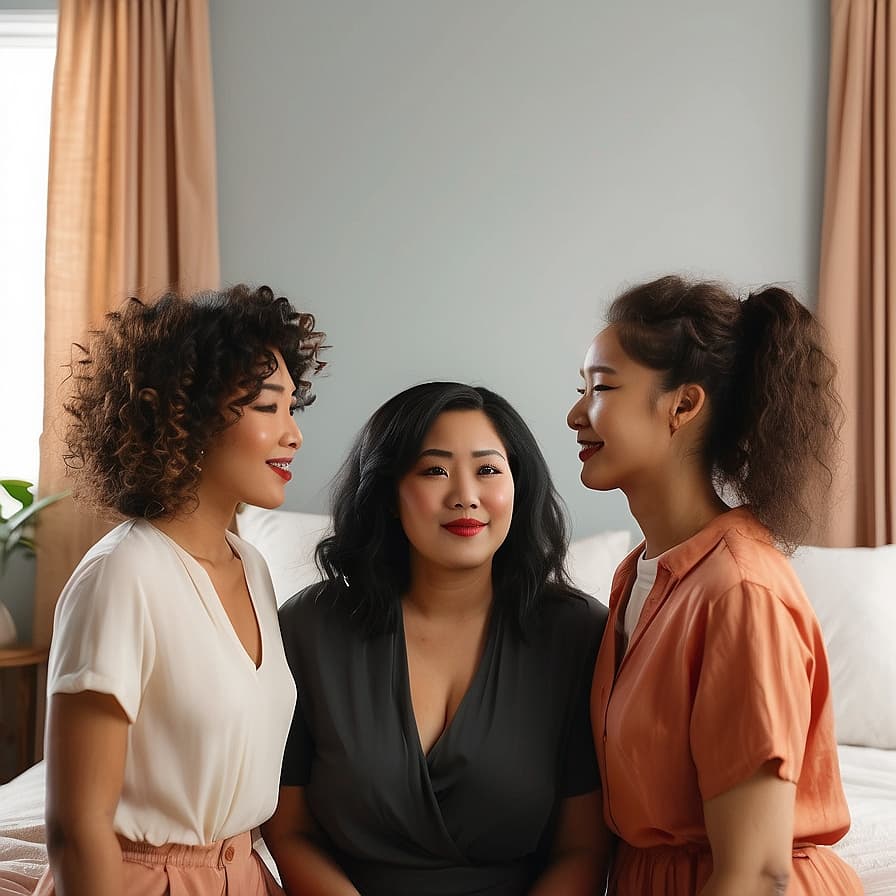
The Hmong sit at an interesting phenotypic crossroads — clearly East Asian in baseline morphology but with features that mark them apart from Han Chinese, Vietnamese, or Lao majority populations among whom they live. The most consistent signature is a compact, sturdy build paired with finer, often delicate facial features and skin that runs notably lighter than lowland Southeast Asian neighbors.
Hair is almost universally jet black or very dark brown, straight to faintly wavy, with the dense coarse texture typical of East Asian populations. Greying often comes late. Eye color sits in the dark brown to near-black range; the epicanthic fold is near-universal, though the fold itself tends to be softer and the palpebral fissure slightly wider and more open than in northern Han populations — eyes that read as almond-shaped rather than narrow. Eyelid crease presence varies; monolids are common but not the rule.
Skin tone clusters in Fitzpatrick III–IV, with warm yellow-to-olive undertones. Mountain-village Hmong from Guizhou and northern Laos often present lighter, cooler-toned skin from generations of high-altitude life with limited sun exposure; diaspora Hmong Americans similarly trend lighter. The Pa-Hng and southern Xong branches sometimes show warmer, more sun-weathered tones.
Facially, Hmong tend toward broader, lower-bridged noses with rounded tips and moderate alar width — less projected than Han averages. Cheekbones are high and broad, jawlines often softly tapered rather than angular, producing the heart-shaped or rounded face seen in figures like Sunisa Lee and Brenda Song. Lips are medium-full, well-defined, with a clear cupid's bow.
Stature is the group's most distinctive anthropometric trait: Hmong run notably shorter than surrounding populations, with adult men typically 5'2"–5'6" and women 4'9"–5'2". Builds are compact and densely muscled — the same body composition that produces Olympic weightlifters and flyweight boxers from Miao communities in China. Diaspora-born generations show meaningful height gains from improved nutrition, but the stocky, low-center-of-gravity frame remains characteristic.
Data depth
59/100Coverage of image-grounded phenotype observations · drives AI generation diversity
- Sample size
- 30/40· 27 images
- Image quality
- 19/30· 37% high
- Confidence
- 10/20· mean 0.69
- Source diversity
- 0/10· wikipedia
- ·Wikipedia-only source — not population-representative
Observed Distribution — Image Sample
Empirical observations from analyzed photographs · supplementary signal, not population truth
Sample: 27 images analyzed (27 wikipedia). Quality: 10 high, 10 medium, 6 low, 1 very_low. Avg analyzer confidence: 0.69.
Skin tone (Fitzpatrick): II (7%), III (26%), IV (52%), unclear (15%)
Hair color: black (67%), gray/white (22%), dark brown (7%), unclear (4%)
Hair texture: straight (67%), wavy (15%), covered (19%)
Eye color: dark brown (81%), unclear (19%)
Epicanthic fold: 85% present, 0% absent, 15% unclear
Caveats: Sample is 100% Wikipedia notable people — skews toward male, public-life, and modern figures, not population-representative.
Last aggregated: May 7, 2026
Explore phenotype categories
Structured taxonomy with peer-reviewed scales · 22 anatomical categories
Notable Hmong People
46 reference figures — sourced from Wikipedia
- Dia Cha — author, former professor and anthropologist, St. Cloud State University, Minn…
- Mai Na Lee — historian and University of Minnesota professor
- Vang Pobzeb — PhD. Laos and Hmong Scholar; founder and past President of Lao Human Rights C…
- Ahney Her — actress, best known as Sue Lor in Gran Torino
- Bee Vang — actor, best known as Thao Vang Lor in Gran Torino
- Brenda Song — Disney channel actress/teen star, known for The Suite Life of Zack & Cody and…
- Doua Moua — actor, known for Gran Torino and Disney's Mulan.
- Long Qingquan — 龙清泉, Miao Olympian; won a gold medal in Men's 56 kg weightlifting for China i…
- Sunisa Lee — artistic gymnast, first Hmong-American to qualify for the US Olympic Team, 20…
- Xiong Chaozhong — Xiong Zhong Zhao, 熊朝忠, Miao (Hmong) light flyweight boxer of Wenshan, China
- Zou Shiming — 邹市明, the most successful amateur boxer from the People's Republic of China; w…
- Cy Thao — Minnesota State Representative
- Foung Hawj — 侯祝福 | ຝົງ ເຮີ), pioneer Hmong-American broadcaster; media artist; Minnesota S…
- Joe Bee Xiong — first Hmong American elected to public office in the state of Wisconsin, serv…
- Lormong Lo — former Omaha City Councilman
- Mai Vang — first Hmong elected to Sacramento City Council in 2020.
- Mee Moua — Minnesota State Senator
- Noah Lor — first Hmong American to be elected Mayor Pro-Tempore in the City of Merced's …
- Pa Kao Her — after the Secret War in Laos, Her fled to Thailand and organized a political …
- Pany Yathotou — the first Hmong woman to become the vice president of Laos and is currently s…
- Sheng Thao — First Hmong Woman to serve on the Oakland City Council
- Steve Ly — First Mayor in the United States of America of Hmong descent - Mayor of Elk G…
- Touby Lyfoung — Hmong politician in Laos, served in several ministries in the Royal Lao Gover…
- Cao Lu — idol singer of Korean group Fiestar
- Techapella — Laolee Xiong, founder of The Vocal Network a cappella group and Techapella si…
- A2K — Lexus ”Lexi” Vang, contestant of survival show A2K former member of American/…
- Luj Yaj — singer from Thailand
- Pao Houa Her — photographer, first Hmong graduate of Yale University's Photography MFA progr…
- Payengxa Lor — the first Hmong woman to be crowned as Miss Universe Laos 2022 and was one of…
- Song Zuying — 宋祖英, ethnic Miao Chinese singer
- Houa Vue Moua — author and community activist
- Kao Kalia Yang — Hmong American writer; author of The Latehomecomer: A Hmong Family Memoir; he…
- Shen Congwen — 沈从文, Miao Chinese writer from the May Fourth Movement
- Doualy Xaykaothao — freelance American journalist and radio producer known for her work with NPR
- minister — Chervang Kong Vang, minister who established United Christians Liberty Evange…
- Wang Zhiming — Miao pastor; memorialized above the Great West Door of Westminster Abbey
- Pa Chay Vue — a leading member of the Madman's War, a rebellion against the French colonial…
- Qin Liangyu — 秦良玉, Miao Chinese General of the Ming Dynasty; highest ranking female general…
- Vang Pao — Royal Lao Army Major General; revered Hmong Leader; commander of CIA-supporte…
- Vu Pa Chay — Hmong: Vwj Paj Cai, Hmong Vietnamese: Vux Pax Chai, a Hmong leader who revolt…
- Zong Zoua Her — a Hmong anti-Pathet Lao and leader of a resistant group in Laos.
- Cherzong Vang — St. Paul Community Leader; Lao and Hmong veterans' leader, Lao Veterans of Am…
- Wangyee Vang — President of Lao Veterans of America Institute; Lao and Hmong community veter…
- Xao "Jerry" Yang — 2007 World Series of Poker Main Event Champion and currently owner of several…
- Chai Vang — ex-National Guardsman; convicted multiple murderer
- The Spirit Catches You and You Fall Down — Lia Lee, subject of the 1997 book The Spirit Catches You and You Fall Down
Generate Hmong AI Content
Use this ethnicity's phenotype data to create AI-generated content with accurate physical traits and cultural context.
Open Creator Studio