
Gelao Erotic
Guizhou (China)
Kra–Dai / Kra / Gelao
Taoism, Buddhism
East Asia
About Gelao People
The Gelao are one of the older known peoples of what is now Guizhou — likely descended from the Liao, who Chinese chronicles record as already inhabiting the southwestern hills more than two thousand years ago. Today they number somewhere over five hundred thousand, scattered across Guizhou's karst country in pockets that often sit a valley or a ridge apart from the larger Han, Miao, and Yi populations around them. That fragmentation is not incidental. It shapes almost everything about how the Gelao have survived as a recognizable people: in patches, by intermarriage at the edges, and by holding onto a few defining things while letting others go.
Language is the clearest case. Gelao belongs to the Kra branch of the Kra–Dai family — a small, archaic-looking branch whose other members (Lachi, Buyang, Pubiao) cling on in similarly small communities scattered across the China–Vietnam borderlands. Linguists treat Kra as one of the keys to reconstructing what early Kra–Dai looked like before Thai and Lao spread south. The hard fact for the Gelao themselves is that the language is in steep decline: most ethnic Gelao now speak Southwestern Mandarin, Miao, or Yi as a first language, and fluent Gelao speakers are concentrated in a handful of villages and counted in the low thousands. The dialects that remain are divergent enough that speakers from different villages often can't understand one another.
Religious life is layered rather than singular. Folk practice — ancestor veneration, household and tutelary spirits, ritual specialists who handle illness, weddings, and funerals — sits underneath a Taoist and Buddhist overlay absorbed over centuries of contact with Han neighbors. The most distinctive surviving custom is the chiyu jie, the Eating-New-Grain Festival, held in the seventh or eighth lunar month when the first ears of rice are ready: the new grain is offered to ancestors and to the dogs, on the older idea that dogs originally brought rice to humans. Tooth-blackening, once widespread among Gelao women as a marker of adulthood and beauty, has effectively disappeared within the last two generations.
What's left is a people defined less by a unified culture than by a long, stubborn persistence in the same hills, under steady pressure from larger neighbors, holding to a thinning language and a calendar of rites that still mark them out from the villages over the next ridge.
Typical Gelao Phenotypes
Reference for AI generation — hair, eyes, skin, facial structure, build
The Gelao are one of southwest China's smallest recognized minorities, concentrated in the limestone uplands of northwestern Guizhou with smaller pockets in Yunnan, Guangxi, and northern Vietnam. Their phenotype sits within the southern East Asian / northern Southeast Asian cline — closer to neighboring Miao, Buyi, and Zhuang populations than to Han from the central plains — with centuries of intermarriage softening any sharply distinctive markers.
Hair is uniformly black to very dark brown, coarse to medium in shaft thickness, and predominantly straight or with a faint wave; tight curl is essentially absent. Greying tends to come late. Eyes run dark brown to near-black, with the epicanthic fold near-universal and a single eyelid (monolid) common, though a low double crease appears in a noticeable minority — more often among younger generations photographed today. The palpebral fissure is typically narrow and slightly upward-slanting, though less pronounced than in northern Han or Mongolic populations.
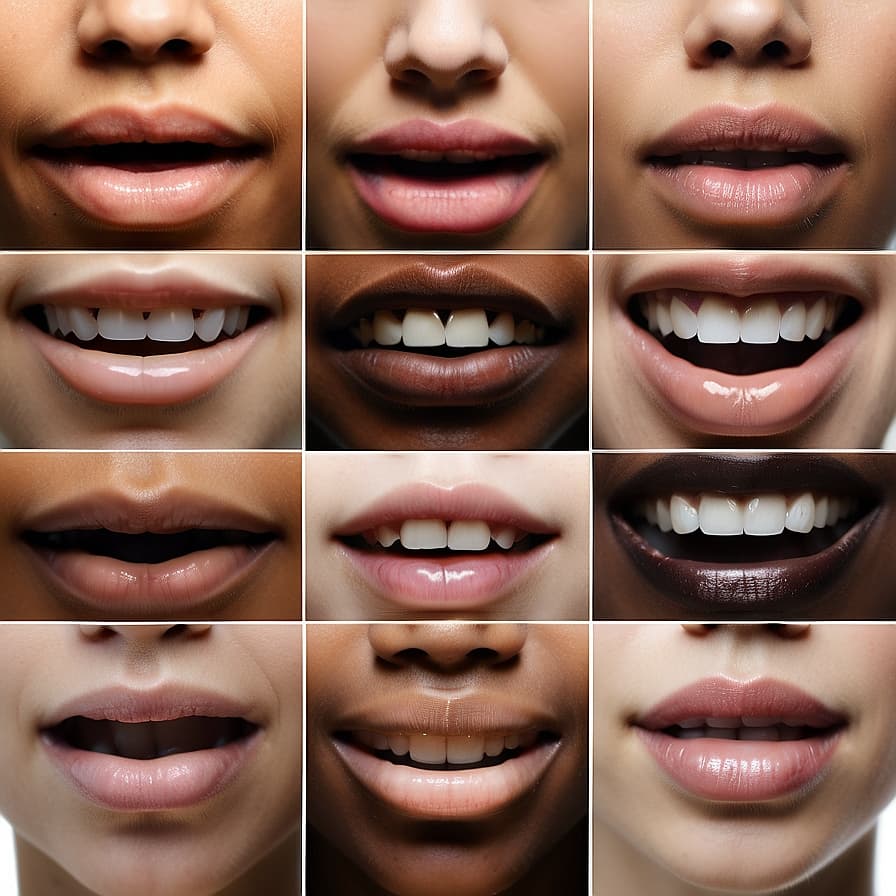
Skin tones cluster in Fitzpatrick III to IV, with warm yellow-to-olive undertones rather than the cooler porcelain end seen further north. Agricultural Gelao who work the terraced hillsides tan readily into a deeper bronzed IV; urbanized younger women often present noticeably lighter. Facial structure tends toward moderate breadth with softly rounded rather than angular cheekbones, a lower nasal bridge with a wider alar base than northern Chinese norms, and lips of medium fullness — the upper lip often thinner than the lower. Jawlines are generally tapered rather than square.
Build is small and wiry. Adult men commonly fall in the 160–168 cm range and women 150–158 cm, with light-to-medium frames, narrow shoulders relative to stature, and low average body fat shaped by mountain agriculture. The Gelao are anthropometrically among the shorter Kra–Dai-speaking populations, and the historical split between Qau, Tolo, A'ou and other sub-branches produces only subtle phenotype variation today, mostly in skin depth and hair coarseness.
Data depth
0/100Coverage of image-grounded phenotype observations · drives AI generation diversity
- Sample size
- 0/40· 0 images
- Image quality
- 0/30· 0% high
- Confidence
- 0/20
- Source diversity
- 0/10
- ·No image observations yet
Explore phenotype categories
Structured taxonomy with peer-reviewed scales · 22 anatomical categories





Generate Gelao AI Content
Use this ethnicity's phenotype data to create AI-generated content with accurate physical traits and cultural context.
Open Creator Studio