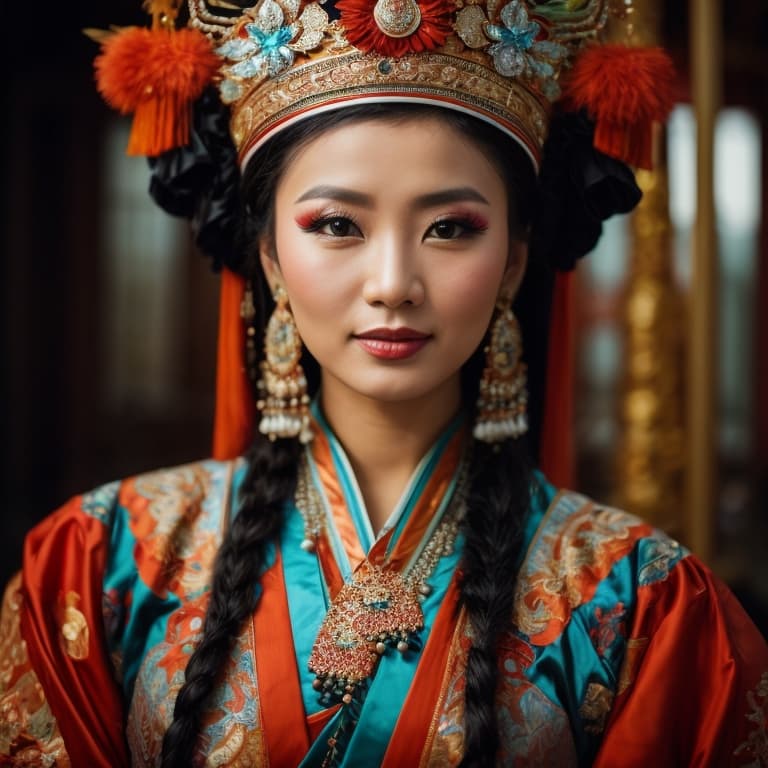
Evenks Erotic
Russia, China
Tungusic / Evenki
Shamanism
East Asia
About Evenks People
The Evenks are reindeer people of the boreal forest, scattered in small communities across an enormous arc that runs from the Yenisei basin in central Siberia eastward to the Pacific and down into the larch forests of northeastern China and northern Mongolia. Despite that range — larger than most countries — they number only around forty thousand, and their settlements are often a few families deep, separated by hundreds of kilometres of taiga. The traditional economy turns on three things in combination: reindeer herding for transport and milk rather than meat, hunting (sable, elk, bear), and seasonal movement between camps. The conical hide-and-bark tent, the chum, is the same dwelling Russian ethnographers drew in the nineteenth century and the one some Evenk families still raise on a winter trapline today.
Evenki belongs to the Tungusic family, the same branch as Manchu, and it splits into a northern and a southern dialect cluster that are no longer fully mutually intelligible. The language is endangered on both sides of the border — Russian and Mandarin have done the heavy lifting of replacement — but it has held on better in the herding camps than in the villages. Older speakers preserve a remarkable vocabulary for reindeer: dozens of distinct terms by age, sex, antler stage, and disposition, the kind of granularity that disappears the moment a generation stops working with the animals.
Religious life is shamanic in a strict, technical sense — the word shaman itself comes from Evenki šamán, and the Evenks are the people anthropologists were describing when they coined the category. The shaman's work is practical: locating game, treating illness, escorting the souls of the dead, mediating with the spirits of the river, the fire, and particular animals. Soviet authorities suppressed the tradition aggressively from the 1930s onward, executing or exiling working shamans, and the lineage broke in many regions. What survives today is partly continuous practice in remote areas and partly a deliberate revival, sometimes blended with Russian Orthodoxy in the west and with Tibetan Buddhist elements in the south.
Subgroups split largely by geography and economy: the Oroqen and Solon of northeastern China, the Ewenki and Khamnigan of Mongolia and Buryatia, the reindeer-herding Evenks of Yakutia, and the more sedentary forest-hunting groups of the Amur. Each speaks a recognizable variant; each has spent the last century negotiating with a different state.
Typical Evenks Phenotypes
Reference for AI generation — hair, eyes, skin, facial structure, build
The Evenks are a small, widely scattered Tungusic reindeer-herding people whose phenotype reflects northern Siberian and Manchurian ancestry — a population that adapted across millennia to subarctic taiga rather than open steppe, and whose features cluster closer to the broader North Tungusic and Northeast Asian range than to either Mongolic or Turkic neighbors.
Hair is almost uniformly straight and coarse, jet-black or very dark brown, with the heavy shaft thickness typical of Northeast Asian populations. Greying tends to come late. Body and facial hair is sparse — beard growth in men is light, often confined to the chin and upper lip. Eyes are dark brown to near-black; lighter shades are vanishingly rare. The epicanthic fold is near-universal, the palpebral fissure narrow and slightly upslanting, with a relatively flat upper lid platform that gives the eye its characteristic almond set.
Skin tone runs a warm light-to-medium brown, generally Fitzpatrick III–IV, with yellow-bronze undertones; cheeks often carry a deep, weather-burnished flush from generations of cold-wind exposure across the taiga. Faces are broad and flat-planed, with prominent malar bones, a wide bizygomatic span, and a relatively low, broad nasal bridge — noses tend toward medium-to-broad alar width with a moderate tip, less projecting than among neighboring Yakuts or Mongols. Lips are medium-full, the lower slightly fuller than the upper. Jaws are squared rather than tapered, and the chin is often modest.
Stature is short to medium — adult men commonly in the 160–168 cm range, women proportionally shorter — with stocky, thick-limbed builds, short distal segments, and the cold-adapted body composition documented across Siberian Tungusic groups. Sub-group variation is real but subtle: the southern Hamnigan branch, long intermarried with Buryat Mongols, often shows a slightly more Mongolic cast — rounder face, heavier eyefold — while northern taiga Evenks (Yakutia, Evenkiysky District) trend leaner-featured, with sharper malars and the lighter, ruddier skin associated with high-latitude life.
Data depth
21/100Coverage of image-grounded phenotype observations · drives AI generation diversity
- Sample size
- 6/40· 2 images
- Image quality
- 0/30· 0% high
- Confidence
- 15/20· mean 0.78
- Source diversity
- 0/10· wikipedia
- ·No image observations yet
- ·Wikipedia-only source — not population-representative
Explore phenotype categories
Structured taxonomy with peer-reviewed scales · 22 anatomical categories
Notable Evenks People
17 reference figures — sourced from Wikipedia
- Evenkiysky District — old Evenk Autonomous Okrug)
- Bombogor — died 1640), leader of Evenki federation
- Olga Kudrina — c. 1890–1944), shaman
- Semyon Nomokonov — 1900–1973), sniper during World War II
- Nikita Sakharov — 1915–1945), poet, prose writer
- Alitet Nemtushkin — 1939–2006), poet
- Maria Fedotova-Nulgynet — born 1946), poet, children's writer, storyteller
- Galina Varlamova — 1951–2019), writer, philologist, folklorist
- Ureltu — born 1952), writer
- D. O. Chaoke — born 1958), linguist
- Hamnigan — Hamnigan Mongols)
- Bokon — / Yungyuele / Nyukzha
- Chaoke, D. O. — .mw-parser-output cite.citation{font-style:inherit;word-wrap:break-word}.mw-p…
- ISBN — Nedjalkov, Igor (1997), Evenki, London: Routledge, ISBN 978-0-415-02640-6
- Vitebsky, Piers — . Reindeer people: Living with Animals and Spirits in Siberia. Boston: Hought…
- Chi, Zijian — 2013). 《额尔古纳河右岸》 [The Last Quarter of the Moon]. Translated by Humes, Bruce. …
- Gerelchimeg Blackcrane — The Moose of Ewenki 《鄂温克的驼鹿》, picture book written by Gerelchimeg Blackcrane …






Generate Evenks AI Content
Use this ethnicity's phenotype data to create AI-generated content with accurate physical traits and cultural context.
Open Creator Studio