Chukchi Erotic
Chukchia
Chukotko-Kamchatkan / Chukchi
Russian Orthodoxy
Chuvans
East Asia
About Chukchi People
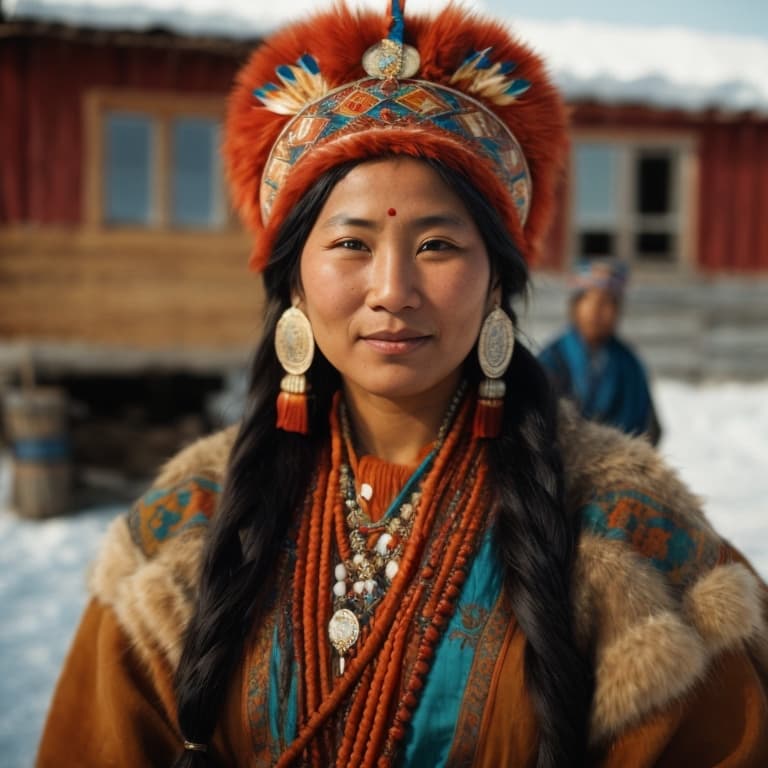
The Chukchi live at the far northeastern edge of Siberia, on a peninsula that pushes into the Bering Sea opposite Alaska. The land is treeless tundra giving way to coastal ice, and the Chukchi have historically split themselves along that geography: the inland reindeer herders, who follow their animals across the interior, and the coastal hunters, who work the sea ice for walrus, seal, and bowhead whale. The two groups speak the same language and share a name for themselves — Lygoravetlat, "the real people" — but they have always operated as somewhat distinct economies, trading reindeer meat and skins for sea-mammal fat and hide.
Their language, Chukchi, sits at the head of the small Chukotko-Kamchatkan family, which has no demonstrated relatives outside the region — a linguistic island shared with Koryak, Itelmen, and a handful of others. It is famous among linguists for vowel harmony and for elaborate noun incorporation, and notably for a historical pattern in which women and men used slightly different consonants in everyday speech. The Chuvans, a smaller group long settled along the Anadyr River, were Chukchi-adjacent but absorbed heavy Russian and Yukaghir influence; many today speak Russian as a first language and identify as a distinct people.
The Chukchi are the rare Siberian people the Russian Empire never fully subjugated. After a series of failed military campaigns in the eighteenth century, Saint Petersburg essentially gave up and settled for trade. That late incorporation matters: it preserved the herding economy and the indigenous religious life — a shamanic system organized around the spirits of animals, weather, and place — well into the Soviet period. Russian Orthodoxy arrived through missionaries and later through state schools, and today most Chukchi are at least nominally Orthodox, but practical life still bends toward older practices, especially around hunting and the reindeer year.
Soviet collectivization in the twentieth century forced the herding bands into state farms and pushed coastal communities into fixed villages, which broke the rhythm of seasonal migration without quite ending it. The post-Soviet collapse of those state structures has been hard — alcoholism, unemployment, and a shrinking population are real — but reindeer herding persists, sea-mammal hunting persists, and the language is still taught, if no longer dominant, in the schools of Chukotka.
Typical Chukchi Phenotypes
Reference for AI generation — hair, eyes, skin, facial structure, build
The Chukchi present one of the most structurally distinctive Arctic phenotypes — a cold-adapted morphology shared in part with Yupik and Koryak neighbors, but with traits that set them apart from the East Asian groups they're sometimes lumped with. Hair is uniformly black or near-black, coarse, and pin-straight, with very low rates of wave or curl. Greying tends to come late, and beard growth in men is sparse. Hair loss with age is uncommon compared to European populations.
Eyes are dark brown, often appearing nearly black. The epicanthic fold is near-universal and tends to be more pronounced than in southern East Asian groups, with a heavier upper lid and a slight outer-corner upslant. Palpebral fissures read as narrow, an adaptation that reduces glare from snow and wind. Skin sits in the Fitzpatrick III–IV range with a warm, slightly coppery undertone — visibly darker than Han Chinese or Japanese skin, and often weathered earlier on the cheeks and nose from cold and UV reflection off snow.
The facial structure is the most identifying feature. Cheekbones are exceptionally broad and high, the malar projection forward rather than only lateral, giving a flat midface with a low, wide nasal bridge and relatively narrow alar base — the classic "cold-climate" nose that warms inhaled air. The jaw is broad and squared, the chin modest, and lips are medium in fullness with a defined vermilion border. The face overall reads rounder and flatter than in Mongolic populations.
Build is short to medium — adult men typically 160–168 cm, women shorter — with stocky, barrel-chested proportions, short distal limbs, and a tendency toward higher subcutaneous fat distribution across the trunk. This is textbook Bergmann–Allen morphology. The Chuvan branch, historically intermixed with Yukaghir and Russian settlers along the Anadyr basin, often shows lighter skin, occasional brown rather than black hair, and a softer cheekbone profile, though the Arctic build still dominates.
Data depth
0/100Coverage of image-grounded phenotype observations · drives AI generation diversity
- Sample size
- 0/40· 0 images
- Image quality
- 0/30· 0% high
- Confidence
- 0/20
- Source diversity
- 0/10
- ·No image observations yet
Explore phenotype categories
Structured taxonomy with peer-reviewed scales · 22 anatomical categories




Generate Chukchi AI Content
Use this ethnicity's phenotype data to create AI-generated content with accurate physical traits and cultural context.
Open Creator Studio