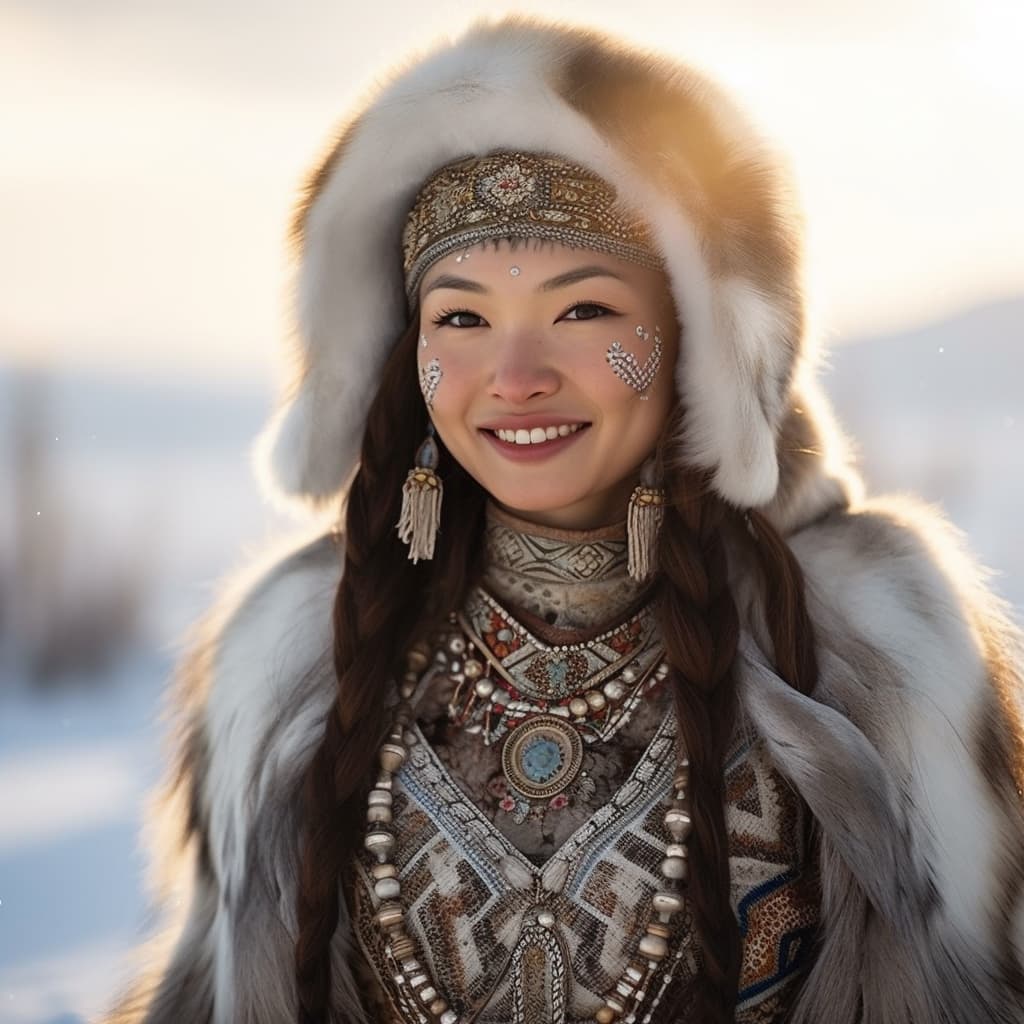
Yakuts Erotic
Yakutia (Russia)
Turkic / Siberian / Yakut
Christianity / Eastern Orthodoxy
Northern Asia
About Yakuts People
The Yakuts — who call themselves Sakha — are the northernmost Turkic-speaking people on earth, and that single fact rearranges everything else about them. Their homeland, the Republic of Sakha, covers a swathe of eastern Siberia roughly the size of India, most of it locked under permafrost and crossed by the Lena River. Winters in the interior routinely hit forty below; the village of Oymyakon, in Yakut country, holds the record for the coldest permanently inhabited place on the planet. A pastoral, horse-and-cattle people speaking a Turkic language ended up here, far from the steppe homelands of their linguistic cousins, and they brought their herds with them — Yakut horses are a stocky, shaggy breed bred to dig through snow for forage and stand outdoors at temperatures that would kill a Mongolian pony.
Linguistically, Sakha sits at the far northeastern edge of the Turkic family, isolated for long enough from Kipchak and Oghuz neighbors that it has absorbed a heavy stratum of vocabulary from the surrounding Tungusic peoples — Evenks and Evens — whose reindeer-herding territory the Sakha pushed into and partly displaced. The migration north is usually placed somewhere in the medieval period, with ancestors moving from the Lake Baikal region under pressure from Mongol expansion. They are unusual among Siberian peoples in having maintained a strong demographic presence in their own republic; the Sakha are a majority in many of its districts, and the language is taught, broadcast, and published in.
Religion in Sakha country is officially Russian Orthodox — conversion came with the Russian colonial advance through Siberia in the seventeenth century — but the older layer is closer to the surface than in most Christianized populations. The pre-Christian system, sometimes called Tengrism or Aar Aiyy, organizes the world into upper, middle, and lower realms and recognizes a class of spirit-intermediaries; shamanic practice was suppressed under both the tsars and the Soviets but never fully erased, and there has been a deliberate revival since the 1990s. The summer festival of Yhyakh, held around the solstice, is the calendrical anchor of Sakha public life — a multi-day gathering involving kumis (fermented mare's milk), the round osuokhai dance, and rituals addressed to the sky and the sun. It functions less like a folk festival staged for outsiders and more like a national holiday a people throws for itself.
Typical Yakuts Phenotypes
Reference for AI generation — hair, eyes, skin, facial structure, build
The Yakuts (Sakha) sit at one of the most extreme cold-adapted phenotype clusters on the planet, and it shows in the face. The build is compact and powerfully proportioned — short to medium stature, broad shoulders, short distal limbs relative to torso (Allen's rule, expressed clearly here), and a tendency toward dense subcutaneous fat layering that flattens the surface contours of the face and limbs. Wrestlers like Roman Dmitriyev and Pavel Pinigin show the type cleanly: low center of gravity, thick neck, wide ribcage, short forearms.
The face is the most distinctive feature. Cheekbones are exceptionally wide and laterally projected — among the widest bizygomatic measurements recorded in any population — giving a strong diamond or pentagon outline. The jaw is broad but tapers to a modest chin. Foreheads tend to be low and broad. Nose bridges are low and narrow at the root, with moderate alar width and a slightly upturned tip; the overall nasal profile is short, an adaptation to extreme cold-air humidification. Lips are medium in fullness, often with a defined philtrum.
Eyes are almost universally dark brown to near-black, with a near-universal, well-developed epicanthic fold and a notable mongolian fold over the upper lid that narrows the visible eye opening. Eye placement is typically wide-set. Brows are straight and not heavy. Hair is straight, coarse, and jet-black, with very low rates of waviness; graying tends to come late. Facial and body hair is sparse in men.
Skin sits in the Fitzpatrick III–IV range, with a warm yellow-olive to light bronze undertone — paler than southern Mongolic groups owing to the high-latitude environment, but distinctly warmer-toned than neighboring Russian Siberian populations. Sun-reddened cheeks (a windburn flush across the malar region) are a familiar sight in winter portraits. Phenotype is fairly homogeneous across the central Sakha heartland; northern Yakuts living among Evenk and Yukaghir neighbors show some narrowing of the face and slightly taller, leaner builds from admixture.
Data depth
57/100Coverage of image-grounded phenotype observations · drives AI generation diversity
- Sample size
- 26/40· 19 images
- Image quality
- 16/30· 32% high
- Confidence
- 15/20· mean 0.71
- Source diversity
- 0/10· wikipedia
- ·Modest sample (n<25)
- ·Wikipedia-only source — not population-representative
Observed Distribution — Image Sample
Empirical observations from analyzed photographs · supplementary signal, not population truth
Sample: 19 images analyzed (19 wikipedia). Quality: 6 high, 11 medium, 2 low, 0 very_low. Avg analyzer confidence: 0.71.
Skin tone (Fitzpatrick): II (21%), III (21%), IV (42%), unclear (16%)
Hair color: black (47%), gray/white (47%), unclear (5%)
Hair texture: straight (84%), wavy (5%), curly (5%), unclear (5%)
Eye color: dark brown (68%), blue (5%), unclear (26%)
Epicanthic fold: 63% present, 32% absent, 5% unclear
Caveats: Sample size 19 is modest — secondary patterns may not be reliable. Sample is 100% Wikipedia notable people — skews toward male, public-life, and modern figures, not population-representative.
Last aggregated: May 7, 2026
Explore phenotype categories
Structured taxonomy with peer-reviewed scales · 22 anatomical categories
Notable Yakuts People
35 reference figures — sourced from Wikipedia
- Eduard Yefimovich Alekseyev — ethnomusicologist
- Georgiy Basharin — professor at the Yakutsk State University
- Zoya Basharina — professor at Yakutsk State University
- Gavriil Ksenofontov — researcher at Irkutsk State University
- Semyon Novgorodov — linguist
- Evgenia Arbugaeva — photographer, Oscar-nominated director
- Arsen Tomsky — founder and CEO of the international ride-hailing service inDrive
- Valery Kuzmin — Soviet pilot
- Fyodor Okhlopkov — was a Soviet sniper
- Vera Zakharova — was a Po-2 air ambulance pilot in the Soviet Air Force during World War II
- Natalya Stroeva — Miss Russia 2018
- Kjuregej — painter, actor, musician
- Sarantuya — mezzo-soprano singer
- Tygyn Darkhan — ruler of the Yakuts
- Roman Dmitriyev — former Soviet wrestler and Olympic champion
- Vasily Gogolev — wrestler
- Eduard Grigorev — freestyle wrestler for Poland
- Gavril Kolesov — checkers player
- Pavel Pinigin — former Soviet wrestler and Olympic champion
- Albina Borisova — theatrical translator
- Sardana Oyunskaya — folklorist
- Aita Shaposhnikova — translator and critic
- Pyotr Toburokov — poet and children's writer
- Alexander Gabyshev — political dissident
- Aisyt — Ajysyt/Ajyhyt), the name of the mythic mother goddess of the Sakha people
- USSR Academy of Sciences Publishing House — Antipin, V. N., ed. (1963). Советская Якутия [Soviet Yakutia]. История Якутск…
- Nauka — Arutyunov, S. A.; Sergeyev, D. A. (1975). Проблемы этнической истории Беринго…
- Yakutsk State University — Gogolev, A. I. (1993). Проблемы этногенеза и формирования культуры [The Yakut…
- Okladnikov, Alexey Pavlovich — 1970). Michael, Henry N. (ed.). Yakutia: Before its incorporation into the Ru…
- Radlov, Vasily Vasilievich — 1893). Aus Sibirien: Lose Blätter aus meinem Tagebuche [From Siberia: Loose L…
- de Roerich, George — 1999). test [Tibet and Central Asia: Articles, Lectures, Translations] (in Ru…
- Skewbald Horde — Ivanov, M. S. (2000). "Замыслившие побег в Пегую орду...: (О топониме Яркан-Ж…
- doi — Karmay, Samten G. (1993). "The theoretical basis of the Tibetan epic, with re…
- ISSN — Khar'kov, V. N.; et al. (2008). "[The origin of Yakuts: analysis of Y-chromos…
- Советская Этнография — Tokarev, S. A. (1949). "К постановке проблем этногенеза" [Problems of ethnic …





More from Northern Asia
Generate Yakuts AI Content
Use this ethnicity's phenotype data to create AI-generated content with accurate physical traits and cultural context.
Open Creator Studio