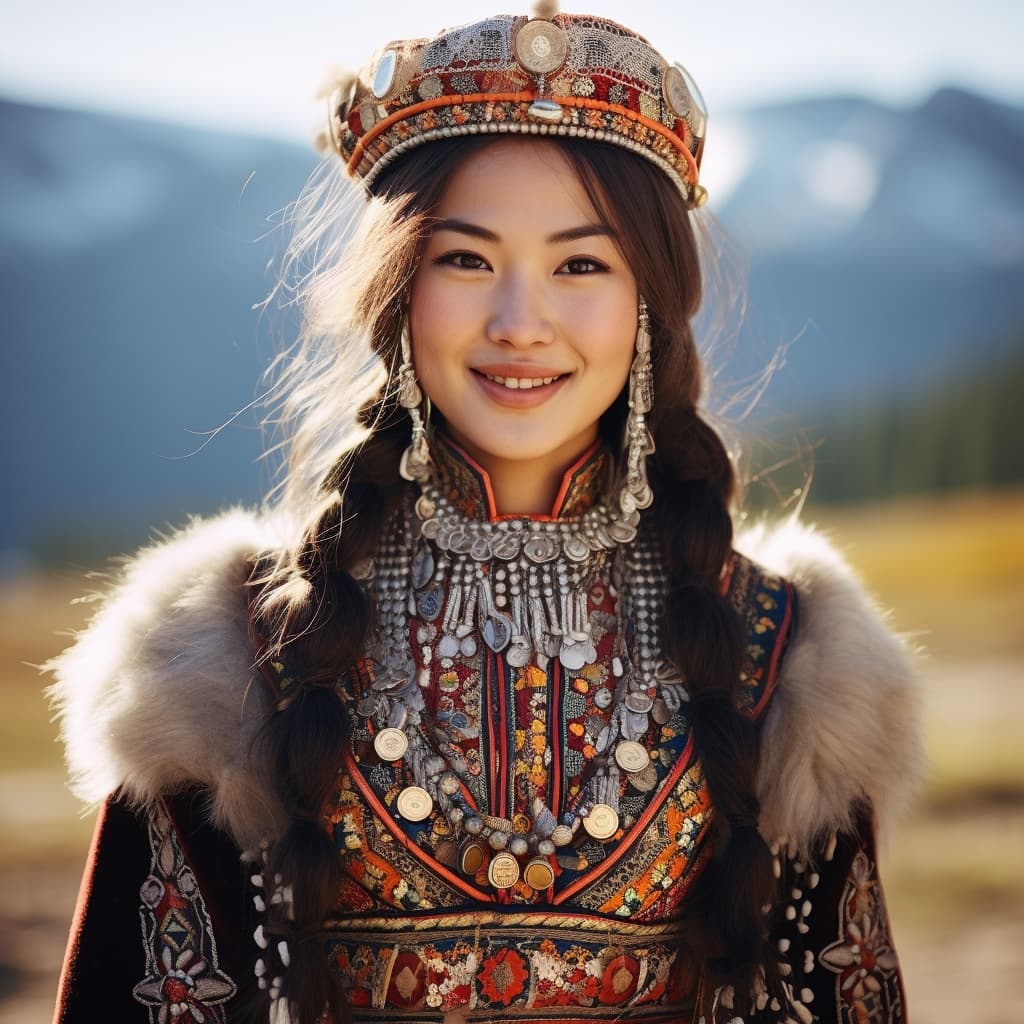
Tuvans Erotic
Tuva (Russia)
Turkic / Siberian / Tuvan
Buddhism / Tibetan Buddhism
Tozhu Tuvans
Northern Asia
About Tuvans People
The Tuvans live in a basin of grassland and taiga tucked between the Sayan Mountains and the Mongolian steppe, and the geography does most of the work of explaining them. They are a Turkic-speaking people whose closest linguistic relatives are scattered across Siberia — Khakas, Altai, Yakut — but whose religious and cultural orientation runs south, into the Buddhist world of Mongolia and Tibet. That split is the basic fact about Tuvan identity: a Turkic tongue spoken by Tibetan Buddhists who herd horses, sheep, yaks, and reindeer on the northern edge of the steppe nomad belt.
The Tuvan language is unusual among Turkic languages for its pharyngeal vowels and the sheer density of its consonant clusters, and it is one of the few Turkic languages where Mongolian loanwords sit comfortably alongside the inherited vocabulary rather than displacing it. Most Tuvans are bilingual in Russian, but the language is in healthy enough condition that it remains the working speech of pastoral households and small towns outside Kyzyl. The Tozhu, a forest-dwelling sub-group in the northeast, speak a distinct dialect and keep domesticated reindeer rather than horses — a livelihood shared with a handful of other small Siberian peoples and almost no one else on earth.
Buddhism arrived from Mongolia in the seventeenth and eighteenth centuries and layered itself over an older shamanic tradition without fully replacing it. A Tuvan family today may consult both a lama and a shaman without sensing any contradiction; the Soviet period destroyed most of the monasteries and drove both practices underground, and what has come back since 1990 is a self-conscious revival rather than an unbroken thread. The Dalai Lama has visited, and a new generation of monks trains in India.
Tuva spent the early twentieth century as a nominally independent republic — Tannu Tuva, a country chiefly remembered now by stamp collectors — before being absorbed into the Soviet Union in 1944. That late incorporation is part of why so much of the older pastoral life survived: collectivization arrived, but only briefly, and the herding economy reasserted itself. The cultural export Tuvans are best known for abroad is khoomei, the throat-singing tradition in which a single voice produces a sustained drone and a whistled overtone melody simultaneously. It is genuinely difficult, genuinely strange to a first-time listener, and central enough to Tuvan self-presentation that performers routinely carry it into concert halls from Moscow to San Francisco.
Typical Tuvans Phenotypes
Reference for AI generation — hair, eyes, skin, facial structure, build
Tuvans sit at the South Siberian crossroads where Central Asian Turkic populations met Mongolic and Yeniseian groups, and the phenotype reads as a clear North Asian / Mongolic profile with subtle Turkic-Siberian softening. Hair is almost uniformly black to blackish-brown, coarse and straight, with the dense follicular thickness typical of Northeast Asian populations. Graying tends to come late and stay sharp rather than yellowing. Beards and body hair are sparse — closer to Mongolian than to neighboring Turkic groups further west.
Eyes are dark brown to near-black, with a near-universal epicanthic fold and a single (monolid) or low-set crease. Palpebral fissures are narrow and slightly upslanted, set into relatively flat orbital regions. Skin tone runs Fitzpatrick III–IV, a warm yellow-tan undertone that weathers quickly under the steppe sun and high-altitude UV — older herders develop the deep ruddy-bronze cheek flush that shows up clearly on figures like Kongar-ool Ondar.
Facial structure is the most distinctive feature: broad zygomatic (cheekbone) projection, wide bizygomatic-to-bigonial ratio, a low and relatively flat nasal bridge with moderate alar width, and a shorter mid-face. Lips are medium in fullness — neither thin nor everted — and the jaw is squared but not heavy. The overall face shape trends round-to-square rather than oval. Sergey Shoigu shows a more gracile, less broad-cheeked variant common in mixed urban Tuvan lineages.
Build is compact and stocky: men typically 165–172 cm, women 155–162 cm, with short distal limb segments, a long torso, and a barrel-chested adaptation associated with high-altitude pastoralist ancestry. Body composition holds muscle and subcutaneous fat well, useful in a continental climate of −40 °C winters.
The Tozhu branch — taiga reindeer-herders of the northeast — show a slightly more Samoyedic-shifted phenotype: a touch lighter skin, somewhat finer features, and occasional lighter brown eyes, reflecting older Uralic substrate underneath the dominant Turkic-Mongolic layer.
Data depth
37/100Coverage of image-grounded phenotype observations · drives AI generation diversity
- Sample size
- 12/40· 5 images
- Image quality
- 10/30· 20% high
- Confidence
- 15/20· mean 0.77
- Source diversity
- 0/10· wikipedia
- ·Small sample (n<10)
- ·Mostly low-quality source images
- ·Wikipedia-only source — not population-representative
Observed Distribution — Image Sample
Empirical observations from analyzed photographs · supplementary signal, not population truth
Sample: 5 images analyzed (5 wikipedia). Quality: 1 high, 4 medium, 0 low, 0 very_low. Avg analyzer confidence: 0.77.
Skin tone (Fitzpatrick): IV (100%)
Hair color: gray/white (100%)
Hair texture: straight (100%)
Eye color: dark brown (100%)
Epicanthic fold: 100% present, 0% absent, 0% unclear
Caveats: Sample size 5 is small — observed distribution should be treated as suggestive, not definitive. Quality skews toward older or low-resolution photos; phenotype detail may be lossy. Sample is 100% Wikipedia notable people — skews toward male, public-life, and modern figures, not population-representative.
Last aggregated: May 7, 2026
Explore phenotype categories
Structured taxonomy with peer-reviewed scales · 22 anatomical categories
Notable Tuvans People
8 reference figures — sourced from Wikipedia
- Galsan Tschinag — shaman and writer)
- Khertek Anchimaa-Toka — Tuvan/Soviet politician, first non-royal female head of state)
- Khün Khürtü — throat singing music group)
- Sergey Shoigu — Russian Minister of Defence and general)
- Kongar-ool Ondar — throat singer)
- Mongush Kenin-Lopsan — shaman and ethnographer)
- Albert Kuvezin — throat singer and guitarist)
- Vladimir Oidupaa — throat singer and bayanist)


More from Northern Asia
Generate Tuvans AI Content
Use this ethnicity's phenotype data to create AI-generated content with accurate physical traits and cultural context.
Open Creator Studio