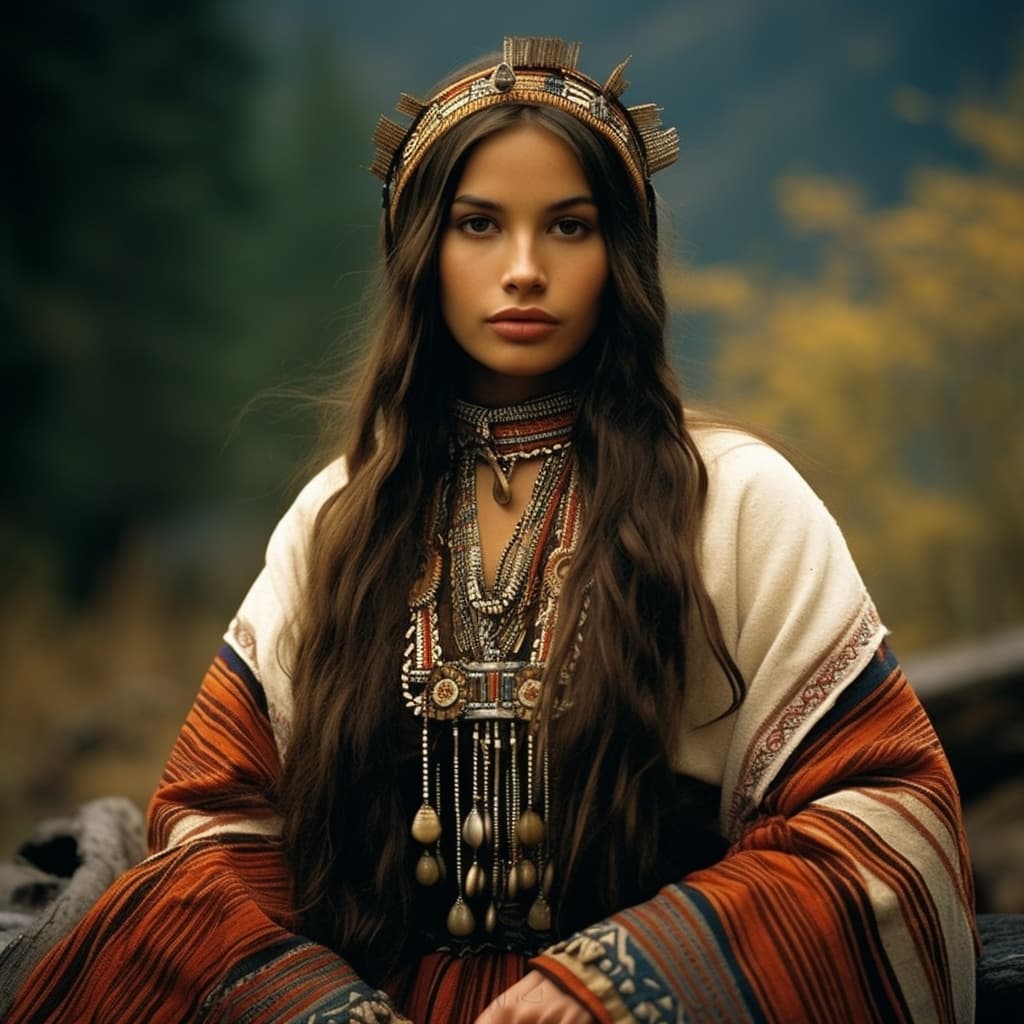
Mapuche Erotic
Araucanía (Chile, Argentina)
Mapudungun
Christianity
Huilliche, along with Mestizos such as Chileans
South America
About Mapuche People
The Mapuche are the people who never quite lost. Spanish conquistadors who flattened the Inca within a generation spent the better part of three centuries failing to subdue them, and the frontier they held — roughly the Biobío River in what is now south-central Chile — was acknowledged as a hard border by the Spanish Crown itself in the 1641 Treaty of Quillín. That fact shapes almost everything about how the Mapuche see themselves today: as a nation that negotiated, not a nation that was conquered. The full incorporation of their territory into Chile and Argentina did not happen until the late nineteenth century, through military campaigns both states still soft-pedal in their school curricula.
Their homeland, the Araucanía, runs through temperate rainforest, volcanic foothills, and the lake country straddling the Andes. The Huilliche — "people of the south" — are the southern branch, historically extending down into Chiloé and the wet, windbeaten coast beyond. Centuries of intermarriage and displacement have also produced a large mestizo population in Chile and Argentina who carry Mapuche ancestry without claiming the identity, a quieter form of continuity than the explicit revival movements of recent decades.
Mapudungun, their language, is a linguistic isolate — it has no demonstrated relative, which is unusual in a continent where most surviving indigenous languages slot into recognizable families. It has held on better than many comparable tongues, but it is under pressure, and the urban Mapuche communities around Santiago and Temuco are where the bilingual revival is most visible. Naming conventions still carry weight: a person's name often references a natural feature, an ancestor, or an animal, and the older custom of taking a new name at significant life stages has not entirely disappeared.
Religion is mostly Christianity now, layered atop an older cosmology that has not been tidily displaced. The machi, a ritual specialist who is usually but not always a woman, still operates in many rural communities, and the nguillatún — a multi-day ceremony of prayer, dance, and offering held in a cleared circular ground — is something families travel home for. Politically, the Mapuche question is live and unresolved: land claims, forestry conflicts in the Araucanía, and the legal status of Mapuche autonomy are ongoing flashpoints in Chilean public life, not historical footnotes. To write about the Mapuche only in the past tense is to miss the point entirely.
Typical Mapuche Phenotypes
Reference for AI generation — hair, eyes, skin, facial structure, build
The Mapuche phenotype is shaped by long isolation in the temperate forests and coastal valleys south of the Bío-Bío river, producing one of the more morphologically consistent Indigenous populations of the Southern Cone. Hair is uniformly black to very dark brown, coarse in texture, and almost always straight — wave or curl is essentially absent in unmixed individuals and reads as evidence of European admixture when it appears. Body hair is sparse; facial hair on men grows thinly and late, often confined to the chin and upper lip.
Eyes are dark brown to near-black, set under a moderate epicanthic fold that is less pronounced than in East Asian populations but clearly present, giving the eye an almond shape with a slightly downturned outer corner. Skin tones cluster in Fitzpatrick III–IV, a warm coppery brown with red-bronze undertones rather than the olive cast common in Andean groups further north; cheeks often carry a natural rose flush from the cold, wet Araucanian climate.
Facial structure is the group's most recognizable feature. The face is broad and squared, with prominent malar bones, a flat-bridged nose with moderately wide alae, and a strong horizontal jaw. Lips are medium-full with a defined cupid's bow. Foreheads are typically low and wide. Build is short and compact — men average around 162–165 cm, women around 150–153 cm — with thick torsos, short limbs relative to trunk length, and dense musculature historically tied to a horse-and-warrior culture that resisted Spanish conquest for three centuries.
Sub-group variation is modest. The Huilliche of the southern lakes and Chiloé tend slightly taller and a shade lighter, with somewhat narrower noses, reflecting older contact with coastal populations. Mestizo Chileans of Mapuche descent show the broadest range — lighter skin in Fitzpatrick II–III, hazel or green eyes in a minority, wavier hair — but the broad face, dark eyes, and compact build persist as the dominant inherited signature.
Data depth
0/100Coverage of image-grounded phenotype observations · drives AI generation diversity
- Sample size
- 0/40· 0 images
- Image quality
- 0/30· 0% high
- Confidence
- 0/20
- Source diversity
- 0/10
- ·No image observations yet
Explore phenotype categories
Structured taxonomy with peer-reviewed scales · 22 anatomical categories

Generate Mapuche AI Content
Use this ethnicity's phenotype data to create AI-generated content with accurate physical traits and cultural context.
Open Creator Studio