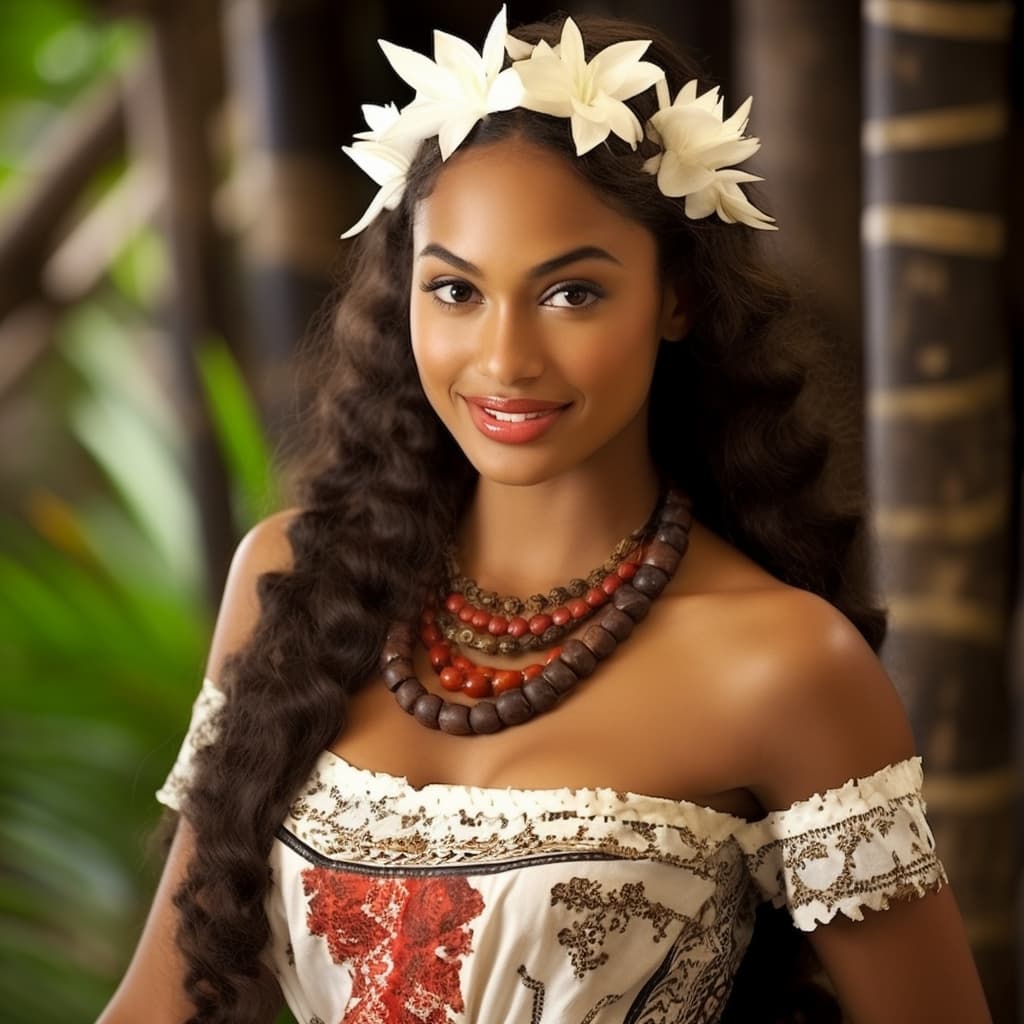
Fijians Erotic
Fiji
Austronesian / Fijian
Christianity / Protestantism
Western Oceania
About Fijians People
Fijians — iTaukei in their own usage, the term that distinguishes the indigenous population from the Indo-Fijian community brought in under British indenture — are the people of an archipelago of more than three hundred islands, of which roughly a third are inhabited. Most live on Viti Levu and Vanua Levu, the two volcanic landmasses that anchor the group; the rest are scattered across the Lau chain, the Yasawas, Kadavu, and a long tail of smaller islands. The geography matters because it shaped the political map: Fiji was never a single kingdom before contact, but a shifting confederation of chiefdoms, and the older loyalties to vanua (land, people, and the bond between them) still organize village life beneath the modern state.
The Fijian language belongs to the Oceanic branch of Austronesian, the same family as Tongan, Samoan, and Maori, though it sits at an interesting hinge — eastern dialects lean Polynesian, western ones diverge sharply, and there are dozens of communalects compressed into a small territory. Standard Fijian (Bauan) was elevated by missionaries in the nineteenth century and is now the lingua franca alongside English and Fiji Hindi. Conversion to Christianity followed those same missionaries, and it took: today the iTaukei are overwhelmingly Methodist, with smaller Catholic and Pentecostal populations, and church attendance remains a structural feature of village Sundays rather than a private preference.
What's distinctive is how thoroughly older institutions survived the conversion. The chiefly system is intact and constitutionally recognized; the Great Council of Chiefs was a real political body until its suspension in 2012. Kava — yaqona locally — is not a tourist novelty but the medium of nearly every formal exchange, from greeting a visitor to settling a dispute, and the protocols around presenting it (the sevusevu) are the closest thing the culture has to a universal grammar of respect. Kerekere, the customary obligation to give what a kinsman asks for, still complicates the cash economy in ways economists find frustrating and Fijians find ordinary.
The harder thread running through modern Fijian life is the relationship with the Indo-Fijian population, now roughly a third of the country. Four coups since 1987 have turned on questions of land tenure, voting weight, and who counts as belonging — questions the indenture system created and independence did not resolve. Fijian identity is shaped as much by that unfinished argument as by anything older.
Typical Fijians Phenotypes
Reference for AI generation — hair, eyes, skin, facial structure, build
Fiji's population is bicultural in a way that makes a single phenotype impossible: indigenous iTaukei (Melanesian with Polynesian admixture, especially in the eastern Lau group) sit alongside Indo-Fijians descended from 19th-century indentured laborers from Bihar, Uttar Pradesh, and South India. The two groups look distinctly different and rarely intermarry, so the profile splits cleanly.
iTaukei Fijians carry the heaviest build in Oceania — broad shoulders, thick torsos, dense bone, and notable musculature even without training, which is why Fijian rugby production is so disproportionate. Stature runs tall for men (often 178–188 cm) with women solidly built. Skin ranges Fitzpatrick V–VI, deep brown to near-black with warm red-brown undertones; coastal and inland communities trend darker than Lauan islanders, who carry visible Tongan admixture and shade lighter with softer features. Hair is coily Type 4, frequently worn full and rounded — the traditional buiniga — naturally jet black, with the auburn-tipped sun-bleaching common across Melanesia. Eyes are dark brown, set under heavy brow ridges with no epicanthic fold. Noses are broad-bridged with wide alar flare, lips full, jaws square and prominent, cheekbones strong. Chiefs like Ratu Epenisa Cakobau show the classic eastern-chiefly look: lighter skin, rounder face, Polynesian-leaning bone structure.
Indo-Fijians retain South Asian phenotype with minimal local admixture after 140 years. Skin is Fitzpatrick IV–V, wheat to medium brown with olive-yellow undertones; North Indian–descended Fijians (the majority) tend lighter than South Indian–descended families. Hair is straight to wavy, jet black, fine to medium texture, often graying late. Eyes are dark brown, almond-shaped, with no fold. Noses are narrower and higher-bridged than iTaukei, lips medium, faces longer and more oval. Build is leaner and shorter — men typically 165–175 cm — with the slim-limbed, lower-muscle-mass profile typical of the subcontinent.
Data depth
74/100Coverage of image-grounded phenotype observations · drives AI generation diversity
- Sample size
- 32/40· 32 images
- Image quality
- 27/30· 53% high
- Confidence
- 15/20· mean 0.75
- Source diversity
- 0/10· wikipedia
- ·Wikipedia-only source — not population-representative
Observed Distribution — Image Sample
Empirical observations from analyzed photographs · supplementary signal, not population truth
Sample: 32 images analyzed (32 wikipedia). Quality: 17 high, 11 medium, 4 low, 0 very_low. Avg analyzer confidence: 0.75.
Skin tone (Fitzpatrick): II (6%), IV (28%), V (59%), VI (3%), unclear (3%)
Hair color: gray/white (56%), black (41%), unclear (3%)
Hair texture: straight (16%), wavy (13%), curly (13%), coily (41%), bald (6%), shaved (6%), covered (3%), unclear (3%)
Eye color: dark brown (84%), brown (3%), blue (3%), unclear (9%)
Epicanthic fold: 3% present, 91% absent, 6% unclear
Caveats: Sample is 100% Wikipedia notable people — skews toward male, public-life, and modern figures, not population-representative.
Last aggregated: May 7, 2026
Explore phenotype categories
Structured taxonomy with peer-reviewed scales · 22 anatomical categories
Notable Fijians People
100 reference figures — sourced from Wikipedia
- Chandra, Rajesh — Vice-Chancellor of the University of Fiji
- Lal, Brij — historian
- Narayan, Paresh — Fiji-born Australian academic
- Pillay, Sarojini — Registrar of the University of Fiji
- Rudrananda, Swami — founder of the Then India Sanmarga Ikya Sangam
- Siwatibau, Savenaca — academic leader; Vice-Chancellor of the University of the South Pacific
- Ali, Shamima — political activist and women's rights campaigner
- Bhagwan-Rolls, Sharon — political activist and women's rights campaigner
- Heffernan, Angie — political activist
- Luveni, Jiko — dentist and AIDS campaigner; Speaker of the Parliament of Fiji since 2014
- Singh, Anirudh — opposed the imposition of the 1990 Constitution
- Siwatibau, Suliana — political activist
- Iqbal, Imraz — political activist, businessman, former journalist
- Khan, Ballu — business tycoon (now deceased)
- Nagindas, Shivlal — Labasa businessman and former Senator
- Nawalowalo, Ratu Josateki — businessman and Chairman of the Kadavu Provincial Council
- Niranjan, Sangeeta — businesswoman
- Punja, Hari — born 1937), business tycoon
- Samisoni, Adi Mere — businesswoman and Member of Parliament
- Seeto, Dixon — business tycoon and president of the Chinese Association of Fiji
- Singh, Ram — Indian-born businessman
- Toganivalu, Davila — businesswoman and newspaper publisher
- Waradi, Taito — President of the Fiji Chamber of Commerce and Industry
- Ratu Kuliniyasi Roko Malani — father of Ratu Wilisoni Tuiketei Malani, chief, elder lineage Gonesau of Vuet…
- Cakobau, Ratu Epenisa — Bauan chief
- Kanakana, Ratu Epeli — Fijian chief (Tui Suva)
- Katonivere, Ratu Aisea — Tui Macuata (paramount chief of Macuata)
- Kadavulevu, Ratu Penaia — Vunivalu of Bau (1901–1914)
- Madraiwiwi, Ratu Joni (the First) — chief (1859–1920)
- Nailatikau, Ratu Epeli (the First) — 1842–1901), Vunivalu of Bau
- Niumataiwalu — founder of the Vuanirewa dynasty in the Lau Islands
- Rasolo — first Tui Nayau
- Rokocegu, Maculeku — Tui Dreketi
- Tui Sigatoka — Rokomatu, Adi Joana, Tui Sigatoka
- Sovasova, Ratu Jovesa — Tui Vitogo (1942–2005)
- Tupou, Ratu Taliai — Tui Nayau (d. 1875)
- Tarau of Tovu Totoya — Fijian chieftainess
- Udre Udre, Ratu — 19th century cannibal
- Ulugalala, Alifereti Finau — Tui Nayau (d. 1934)
- Visawaqa, Ratu Tanoa — Vunivalu of Bau (1800s)
- Uluilakeba I — successor to Rasolo (q.v.) as Tui Nayau, but not so installed
- Acraman, Rodney — former Ombudsman and Chairman of the Fiji Human Rights Commission
- Bainimarama, Meli — CEO of Fijian Affairs Board (December 2006-January 2007; subsequently reemplo…
- Hatch, Hector — former chairman of the Public Service Commission
- Huggett, Stuart — former Chairman of the Public Service Commission
- Jale, Anare — Chief Executive Officer of the Public Service Commission; former Ambassador t…
- Korovavala, Lesi — Chief Executive Officer of the Home Affairs Ministry
- Kotobalavu, Joji — Chief Executive Officer of the Prime Minister's Department
- Naupoto, Viliame — former Navy Commander; former Director of Immigration from January 2007; now …
- Qionibaravi, Adi Litia — Chief Executive Officer of the Fijian Affairs Board
- Ram, Rishi — Chairman of the Public Service Commission and former Ambassador to Japan
- Ridgeway, Peter — former Deputy Director of Prosecutions
- Shameem, Shaista — Director of the Fiji Human Rights Commission
- Tuisolia, Ratu Sakiusa — former Chief Executive Officer of Airports Fiji Limited
- Vakalalabure, Ratu Rakuita — Deputy Speaker of the House, member of House of Representatives of Fiji
- Vakalalabure, Ratu Tevita — Senator, President of the Senate, member of the Great Council of Chiefs, memb…
- Derek Boyer — "The Island Warrior", actor
- Mike Howlett — musician
- Cassius Khan — classical tabla and ghazal player now based in Vancouver, British Columbia, C…
- Malumu ni Tobu kei Naivaukura — musician
- Lagani Rabukawaqa — musician
- Rebecca Singh — television news presenter, now based in New Zealand
- Kula Kei Uluivuya — musician
- Bune, Poseci — diplomat and politician
- Konrote, George — diplomat and politician; Rotuman
- Nailatikau, Ratu Epeli — President of Fiji (since 2009) and former High Commissioner to the United Kin…
- Nandan, Satya — Secretary-General of the International Seabed Authority (1996–present)
- Savua, Isikia — diplomat and former Police Commissioner
- Tavola, Kaliopate — Minister for Foreign Affairs (2000–2006) and former Ambassador to Belgium
- Vitusagavulu, Jesoni — businessman and diplomat, Ambassador to Washington (2005)
- Waqanisau, Jeremaia — career soldier and diplomat; Ambassador to China
- Fatiaki, Daniel — Chief Justice (2002–2007)
- Gates, Anthony — Chief Justice (since 2007)
- Kepa, Sailosi — judge, diplomat, cabinet minister, ombudsman (1938–2004)
- Matanitobua, Naomi — Chief Magistrate
- Mishra, Ghananand — jurist (1916–2005)
- Singh, Ajit Swaran — Fiji-born New Zealand judge
- Tuivaga, Sir Timoci — Chief Justice (1974–2002)
- Bainimarama, Voreqe (Frank) — military commander and interim Head of State (2000; 2006–2007); interim prime…
- Baledrokadroka, Ratu Jone — Lieutenant Colonel and former Acting Land Force Commander
- Driti, Pita — Land Force Commander (as of early 2007)
- Kean, Francis — Navy Commander (as of early 2007)
- Leweni, Neumi — Army spokesman
- Mara, Ratu Tevita — Army Major; former Army Chief of Staff (as of 2006)
- Rabuka, Sitiveni — 1987 coup leader, later prime minister (1992–1999)
- Rabukawaqa, Orisi — Army spokesman
- Saubulinayau, Meli — senior Army officer
- Seruvakula, Viliame — Army officer, who led the counteroffensive against the mutiny at Queen Elizab…
- Sukanaivalu, Sefanaia — war hero (Second World War)
- Teleni, Esala — Naval Captain and former Deputy Commander of the Republic of Fiji Military Fo…
- Waqanisau, Jeremia — career soldier and diplomat; Ambassador to China
- Humphrey Tawake — Captain and Chief Naval Officer
- Semi Koroilavesau — rose to the rank of Commander, prior to running for elected office
- Netani Sukanaivalu — rose to the rank of Lieutenant Commander, prior to running for elected office
- Bulamainaivalu, Kevueli — Assistant Commissioner of Police - Crime
- Driver, Moses — Deputy Commissioner of Police
- Hughes, Andrew — Commissioner of Police
- Khan, Jahir — Senior Superintendent of Police
- Koroi, Jimi — Acting Commissioner of Police (2006–2007)
- Tikotikoca, Romanu — Commissioner of Police






More from Western Oceania
Generate Fijians AI Content
Use this ethnicity's phenotype data to create AI-generated content with accurate physical traits and cultural context.
Open Creator Studio