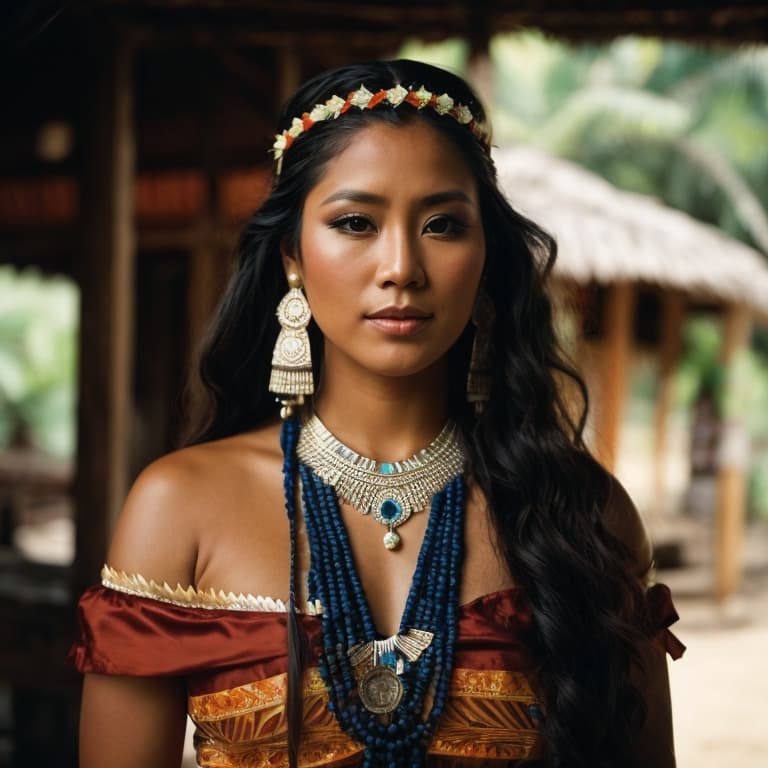
Chamorro Erotic
Mariana Islands (United States)
Austronesian / Chamorro
Christianity / Catholicism
Western Oceania
About Chamorro People
The Chamorro are the indigenous people of the Mariana Islands — Guam and the Northern Marianas — and they have spent roughly four centuries living at the hinge of empires. Spain claimed the archipelago in 1565 and held it until 1898; the United States took Guam after the Spanish-American War while Germany, then Japan, then the U.S. again cycled through the northern islands. Few Pacific peoples have been administered by quite so many flags in succession, and the Chamorro identity that survived this is not a relic but a working synthesis: Catholic in faith, Spanish-inflected in surnames and cuisine, American in passport for those on Guam, and stubbornly Pacific underneath all of it.
The Chamorro language belongs to the Austronesian family — distantly related to Tagalog, Malay, and the languages of Micronesia — but centuries of contact have layered Spanish loanwords so thickly into everyday speech that numbers, weekdays, and many household words come from Castilian rather than the indigenous stock. The language was nearly broken by twentieth-century policy: corporal punishment for speaking Chamorro in American-run schools, forced Japanese instruction during the WWII occupation, and the long monolingual drift afterward. Revitalization is now a serious project, taught in public schools and sustained by elders, though intergenerational transmission remains fragile.
Catholicism arrived with the Jesuits in the 1660s and was imposed at considerable cost — the Spanish-Chamorro Wars and introduced disease cut the pre-contact population by something like ninety percent — but the faith has long since become genuinely Chamorro rather than merely received. Village patron-saint fiestas are the central social calendar, with each pueblo hosting an annual day where extended families set up open tables and feed anyone who walks in. This is the visible face of inafa'maolek, the cultural ethic of mutual care and restored balance that organizes much of village life. Reciprocity in food, in labor, in funeral attendance, in chenchule' — the formal contributions tracked across decades of weddings and rosaries — is not sentiment but social infrastructure.
Chamorro society is matrilineal in inheritance of land and family standing, even under layers of Spanish patronymics, and the maternal line still carries weight in how kinship is reckoned. The pre-contact latte stones — pillared limestone foundations that once held elevated houses — stand in clearings across both Guam and the Northern Marianas, and they remain a living symbol rather than an archaeological curiosity, invoked in flags, civic seals, and the ongoing argument over what political status the islands should hold next.
Typical Chamorro Phenotypes
Reference for AI generation — hair, eyes, skin, facial structure, build
Chamorros carry the phenotype signature of Western Micronesia — a base of Austronesian seafaring ancestry overlaid with substantial Spanish, Filipino, and Mexican admixture from three centuries of colonial contact, plus more recent American and East Asian inflows. The result is a population that reads as broadly Pacific Islander but with consistently lighter skin and finer features than Melanesian neighbors to the south.
Hair runs almost uniformly black to dark brown, thick and coarse-shafted, with texture skewing straight to gently wavy. Tight curls are uncommon outside of partial African or Melanesian admixture. Body hair is sparse to moderate. Eyes are predominantly dark brown to near-black; lighter hazel or amber occurs in mixed-heritage individuals. A subtle epicanthic fold is common but variable — often softer than in East Asian populations, sometimes absent entirely depending on Filipino or European share. Eye shape tends toward almond, set under low-to-moderate brow ridges.
Skin sits in the Fitzpatrick III–IV range — a warm olive to light bronze with golden or coppery undertones, tanning readily and rarely burning. Pia Mia's coloring is on the lighter, more European-leaning end; deeper tropical bronzes are equally typical, especially in Guam and Rota.
Facial structure is notably broad: wide cheekbones, full midface, a nose with a low-to-medium bridge and moderate alar flare, and lips fuller than typical East Asian averages but not as full as Polynesian. Jaws read square and substantial, particularly in men, contributing to the heavyset reputation of Chamorro athletes.
Build is the most distinctive anthropometric feature — Chamorros are among the larger-framed populations in Asia-Pacific. Men commonly reach 5'9"–6'2" with broad shoulders, thick torsos, and powerful lower bodies; Zach Banner at 6'8" and 380 lbs sits at the extreme but reflects a real tendency toward size. Women trend curvier with fuller hips and bust than mainland Asian averages. Northern Marianas Chamorros show slightly more East Asian admixture than Guamanians, producing marginally finer features and lighter skin on average.
Data depth
0/100Coverage of image-grounded phenotype observations · drives AI generation diversity
- Sample size
- 0/40· 0 images
- Image quality
- 0/30· 0% high
- Confidence
- 0/20
- Source diversity
- 0/10
- ·No image observations yet
Explore phenotype categories
Structured taxonomy with peer-reviewed scales · 22 anatomical categories
Notable Chamorro People
17 reference figures — sourced from Wikipedia
- Pia Mia Perez — born 1996), singer-songwriter
- Angel Santos — born 1959), Chamorro Rights Advocate & former Guam Senator
- Craig Santos Perez — born 1980) award-winning poet, essayist, and former university professor
- Theresa H. Arriola — a cultural anthropologist from the Northern Mariana Islands
- Zach Banner — born 1993), former American NFL football offensive tackle for the Pittsburgh …
- Ignacia Bordallo Butler — died 1993), businesswoman and entrepreneur
- Manny Crisostomo — born 1958), Chamorro Pulitzer Prize winner
- Joe Duarte — born 1983), mixed martial artist
- Peter Gumataotao — first Chamorro two-star flag officer in the United States military
- Siobhon McManus — teacher & activist
- Walt Nauta — aide to US president Donald Trump
- Susan Pangelinan — Chamorro-American member of the United States Air Force
- Frank Camacho — martial artist
- Maria Anderson Roberto — born 1880), chaperone for the Navy's Native Nurses program
- Gregorio Sablan — born 1955), Delegate to the U.S. House from the Northern Mariana Islands's at…
- Jon Tuck — martial artist
- Ben Blaz — born 1928), 4 Star General Marine Corps base Guam (Camp Blaz Marine Corps Sta…
More from Western Oceania
Generate Chamorro AI Content
Use this ethnicity's phenotype data to create AI-generated content with accurate physical traits and cultural context.
Open Creator Studio