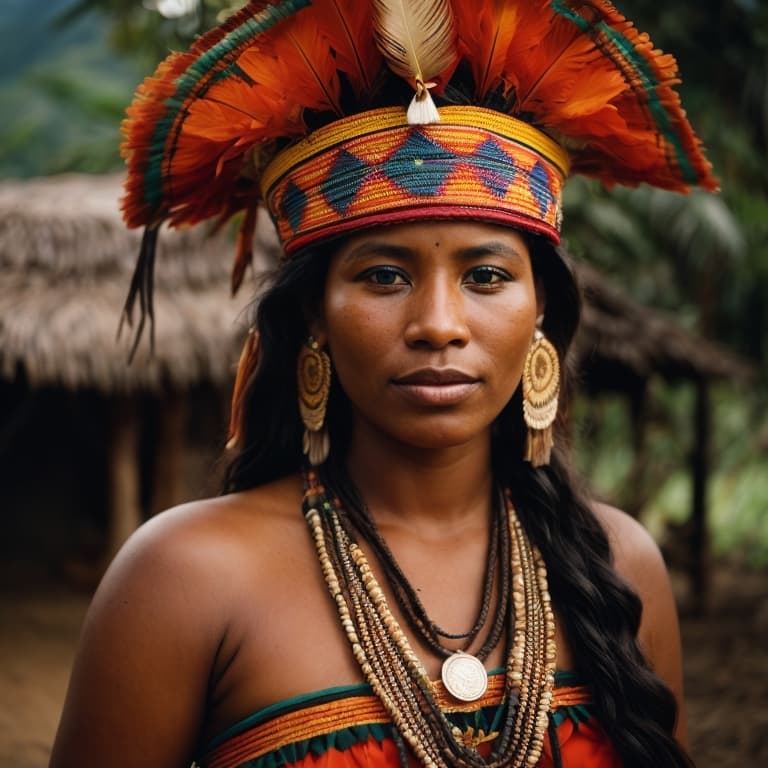
Emberá Erotic
Chocó Department (Colombia), Panama (Darién, Emberá)
Choco / Embera
Shamanism
South America
About Emberá People
The Emberá live along the rivers of the Darién — the band of dense, wet forest that straddles the Colombia–Panama border and famously breaks the Pan-American Highway. They are river people in a literal sense: villages cluster on the banks of the Chucunaque, the Tuira, the Atrato, and their tributaries, with houses raised on stilts above the floodline and dugout canoes doing the work that roads do elsewhere. Movement between settlements has always been by water, and a community's reach is measured in paddle-hours rather than kilometres.
The Emberá language belongs to the small Chocoan family, which sits in relative isolation — linguists have struggled to tie Chocoan convincingly to any of the larger South American stocks, and it is generally treated as its own branch. Within the Emberá there are several mutually intelligible varieties, broadly split between the Northern Emberá (often called Emberá-Catío and Chamí, in the Colombian highlands and Antioquia) and the Southern Emberá of the lowland Chocó and Darién. Their close cousins the Wounaan speak a related Chocoan language and share much of the same territory and material culture, though the two groups maintain distinct identities.
Religious life is built around the jaibaná, a ritual specialist who negotiates with the jai — spirits attached to plants, animals, illnesses, and places. The jaibaná sings the spirits into carved batons and cures, curses, or diagnoses by managing those relationships; healing and harm are treated as the same craft handled by different hands. Evangelical and Catholic missions have made inroads, particularly in Panama, but the jaibaná tradition has proved durable and often coexists with formal religion rather than being displaced by it.
Two visible practices set the Emberá apart even at a glance. Body painting with jagua, the unripe fruit of Genipa americana, produces deep blue-black geometric designs that last a couple of weeks on the skin and are applied for daily life as much as for ceremony. And the carving and weaving traditions — tagua-nut figurines and tightly coiled werregue palm baskets — have become some of the most recognised Indigenous craft work in the Americas. The recent history is harder: the Colombian armed conflict pushed many Emberá communities off their land into urban displacement, and the Darién Gap's transformation into a migrant corridor has put new pressures on territories that were, until very recently, among the least-trafficked forests on the continent.
Typical Emberá Phenotypes
Reference for AI generation — hair, eyes, skin, facial structure, build
The Emberá are a compact, broad-faced Indigenous people of the wet tropical lowlands straddling the Colombia–Panama border, and their phenotype reflects long isolation in the Chocó-Darién rainforest with relatively little post-contact admixture compared to most South American groups. Hair is uniformly black, straight to faintly wavy, coarse-shafted, and typically worn long by both sexes; greying comes late and male-pattern balding is rare. Body and facial hair are sparse — light brows, minimal beard growth, smooth chests and limbs.
Eyes are dark brown to near-black, set under low, slightly puffy upper lids. A soft epicanthic fold is common but not universal — less pronounced than in East Asian populations, more like the subtle inner-canthal fold typical of Amazonian and Chibchan peoples. The palpebral fissure is narrow and slightly downturned at the outer corner, giving a calm, level gaze.
Skin sits in the Fitzpatrick III–IV range with a warm coppery-bronze undertone — the "reddish" cast often noted in lowland tropical Amerindians. Sun-exposed forearms and faces deepen toward a burnished red-brown, while torsos kept under traditional dress stay noticeably lighter. Many Emberá adults wear jagua body paint (deep blue-black geometric patterning from the genipa fruit), which is cultural rather than phenotypic but worth noting as a near-universal visual marker.
Facial structure is short and wide: low, broad cheekbones, a flat-bridged nose with wide alae and rounded tip, a short philtrum, and lips of moderate fullness with a defined vermilion border. The jaw is rounded rather than angular, the chin small. Stature is short — adult men typically 1.55–1.65 m, women 1.45–1.55 m — with stocky, well-muscled builds, short limbs relative to torso, broad shoulders on men and naturally wide hips on women. Body fat distribution is even rather than concentrated. The Northern Emberá of Panama's Darién and the Southern (Chamí, Katío) branches in Colombia's Chocó and Antioquia are phenotypically near-identical; visible differences are dress and adornment, not anatomy.
Data depth
0/100Coverage of image-grounded phenotype observations · drives AI generation diversity
- Sample size
- 0/40· 0 images
- Image quality
- 0/30· 0% high
- Confidence
- 0/20
- Source diversity
- 0/10
- ·No image observations yet
Explore phenotype categories
Structured taxonomy with peer-reviewed scales · 22 anatomical categories






Generate Emberá AI Content
Use this ethnicity's phenotype data to create AI-generated content with accurate physical traits and cultural context.
Open Creator Studio