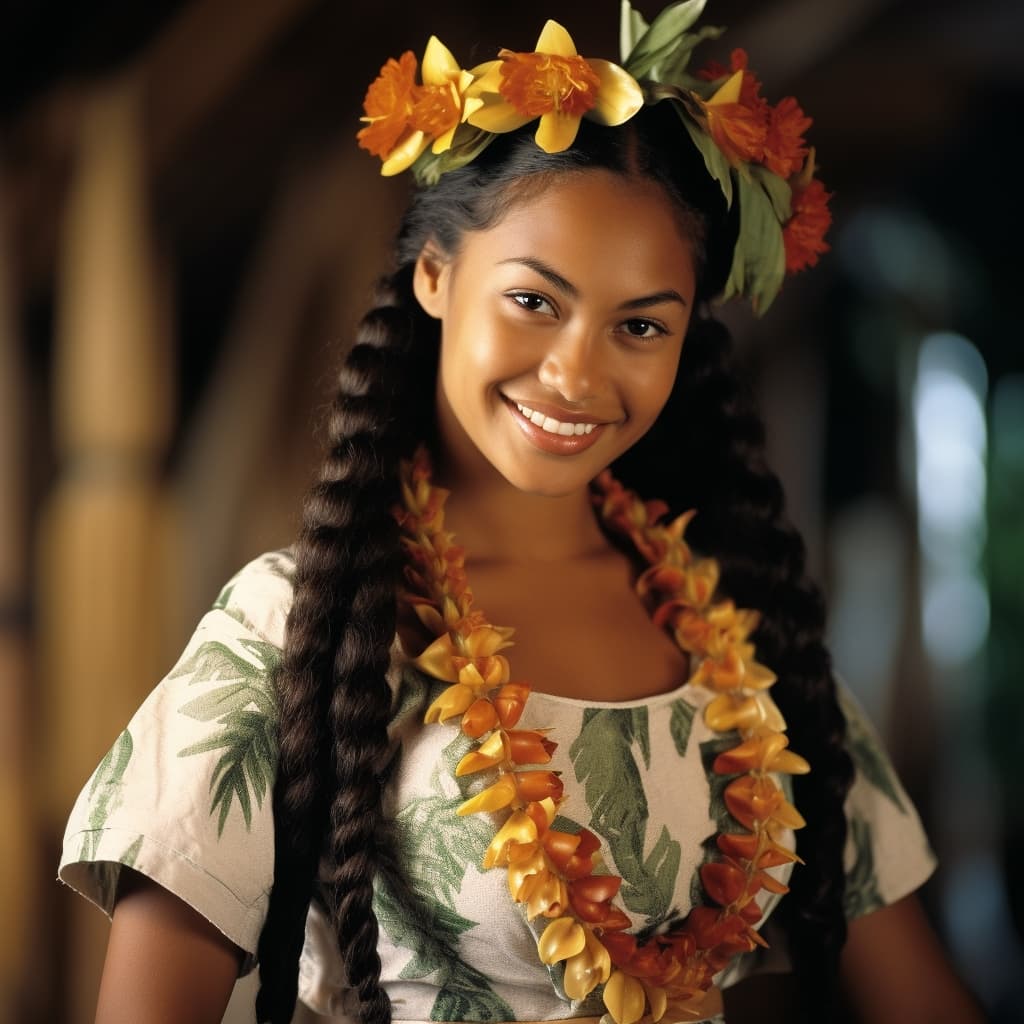
Tokelauans Erotic
Tokelau
Austronesian languages / Malayo-Polynesian languages / Oceanic languages / Polynesian languages / Tokelauan language
Christianity / Congregationalism
West Oceania
About Tokelauans People
Tokelauans are a Polynesian people whose homeland consists of three small coral atolls — Atafu, Nukunonu, and Fakaofo — strung across roughly 170 kilometers of open Pacific north of Samoa. The total land area is about twelve square kilometers, none of it rising more than five meters above sea level, which makes Tokelau one of the most physically constrained inhabited territories on earth and gives the place a certain functional intimacy: nobody on an atoll is ever more than a short walk from anybody else, and the lagoon is always in view. The population on-island hovers around fifteen hundred. A much larger Tokelauan community lives in New Zealand, particularly in the Wellington and Hutt Valley area, and the back-and-forth between island and diaspora shapes a great deal of contemporary life.
The Tokelauan language belongs to the Polynesian branch of the Oceanic family and sits closest to Tuvaluan and Samoan, with Samoan in particular long serving as the language of church and formal address before Tokelauan itself was standardized in writing. Christianity arrived in the nineteenth century and stuck hard: Atafu is overwhelmingly Congregationalist, Nukunonu is Catholic, Fakaofo is mixed but predominantly Congregationalist, and the Sabbath is observed seriously across all three. Sunday quiet on a Tokelauan atoll is a real, audible thing.
Governance is the unusual part. Each atoll runs its own affairs through a taupulega, a council of elders and family heads, and the national government rotates its administrative seat among the three villages every year — there is no single capital. Decisions of consequence still pass through the inati system, an old communal distribution practice in which the day's catch or harvest is divided among every household by share rather than sold. This is not folkloric reenactment; it is how fish actually moves on the atoll. Tokelau remains a non-self-governing territory of New Zealand, and twice in the 2000s its people voted on free association — both referenda fell just short of the two-thirds threshold required for the change, and the question has been quietly shelved since.
Day-to-day life threads through fishing, copra, remittances from relatives abroad, and a striking renewable-energy footprint: in 2012 Tokelau became the first territory in the world to run essentially all of its electricity on solar power, a practical answer to the cost and difficulty of shipping diesel to atolls that sit a full day's boat ride from anywhere.
Typical Tokelauans Phenotypes
Reference for AI generation — hair, eyes, skin, facial structure, build
Tokelauans share the core Western Polynesian phenotype seen across Samoa, Tuvalu, and Tokelau itself — a population shaped by long isolation on three small atolls and close kinship with neighbouring island groups. The look is robust, broad-featured, and deeply pigmented relative to most Polynesian populations, with comparatively little of the Melanesian admixture seen further west.
Hair is almost uniformly black or near-black, thick, and structurally straight to gently wavy — coiled or kinky textures are rare and usually signal recent outside ancestry. Strands tend to be coarse and high-density, producing the heavy, glossy hair characteristic of the region. Greying often comes late. Eyes are dark brown to near-black; lighter shades are uncommon. The eye opening is typically wide and almond-shaped, with a low-set, often slightly puffy upper lid; a true epicanthic fold is uncommon but a soft inner-corner fold occurs in a minority. Brows are full and dark.
Skin sits mainly in Fitzpatrick IV–V — a warm tan-to-brown base with golden or olive undertones rather than the reddish cast common in Māori. Equatorial sun keeps most adults at the deeper end of their natural range, and decades of marine exposure produce visibly weathered skin on older fishermen.
Facial structure is the most distinctive marker: broad and squarish, with wide zygomatic bones, a strong horizontal jawline, and a relatively flat midface. Noses are medium-broad with a low-to-medium bridge and rounded, fleshy tip; alar width is generous. Lips are full top and bottom, with a well-defined vermilion border. Foreheads are broad, chins solid.
Build is the headline trait. Tokelauans, like Samoans and Tongans, are among the most heavily built populations on earth — tall to very tall by Pacific standards (men commonly 175–185 cm), with wide shoulders, deep chests, thick wrists, and dense bone. Body composition trends toward high lean mass and high adiposity simultaneously; the same frame that produces rugby forwards also predisposes to the region's documented diabetes and obesity rates. Women carry the same broad-shouldered, wide-hipped architecture in a softer envelope. Sub-atoll variation between Atafu, Nukunonu, and Fakaofo is minimal — the population is small enough that the three villages are phenotypically continuous.
Data depth
0/100Coverage of image-grounded phenotype observations · drives AI generation diversity
- Sample size
- 0/40· 0 images
- Image quality
- 0/30· 0% high
- Confidence
- 0/20
- Source diversity
- 0/10
- ·No image observations yet
Explore phenotype categories
Structured taxonomy with peer-reviewed scales · 22 anatomical categories






Generate Tokelauans AI Content
Use this ethnicity's phenotype data to create AI-generated content with accurate physical traits and cultural context.
Open Creator Studio