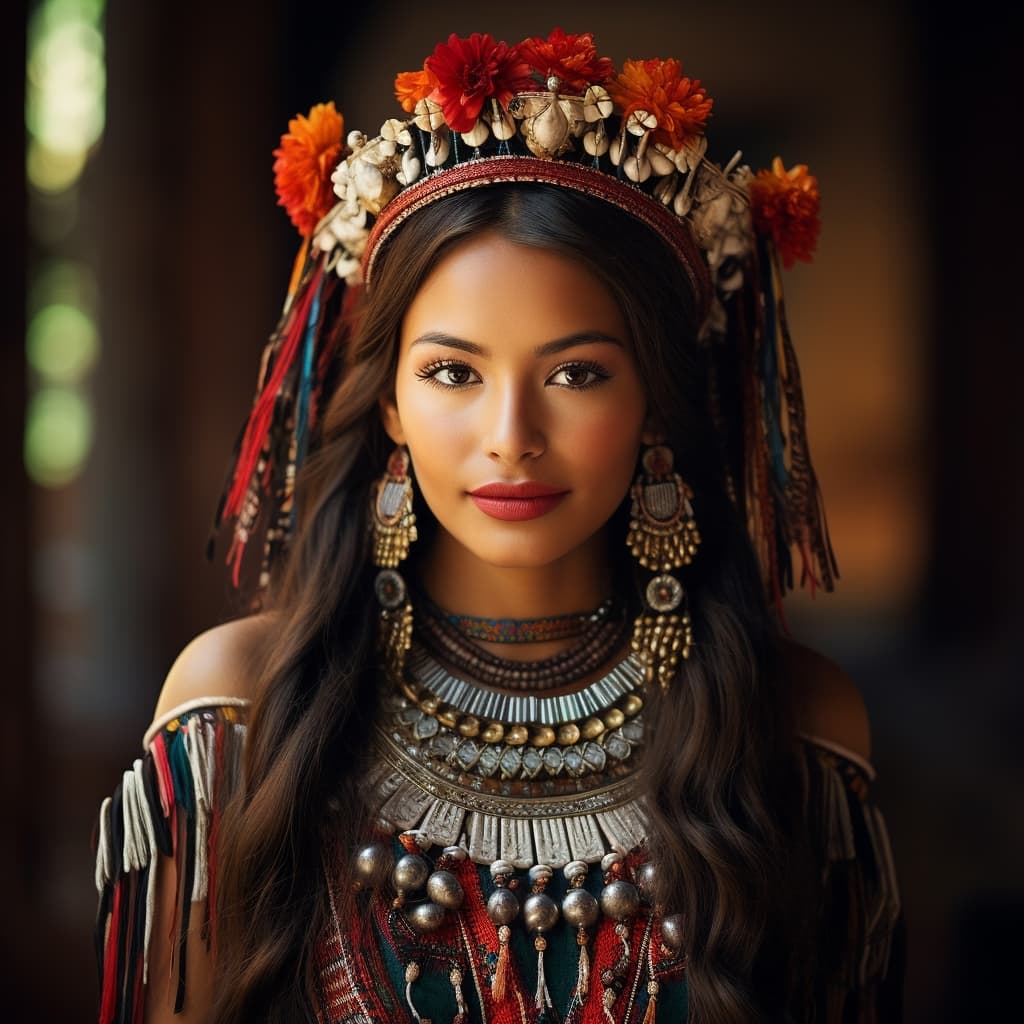
Nahuas Erotic
Mexico
Uto-Aztecan / Nahuatl
Christianity / Catholicism
Huasteca Nahuas, Mexicaneros, Sierra Puebla Nahuas, Guerrero Nahuas, Orizaba Nahuas, Southeastern Puebla Nahuas, Central Nahuas, Pipil, along with Mestizos such as Mexicans
Central America
About Nahuas People
The Nahuas are the largest Indigenous people of Mexico, and the ones whose language quietly shaped the way the rest of the world talks about the Americas — tomato, chocolate, avocado, coyote, chili all come from Nahuatl. They are not a single community but a constellation of them: roughly two million speakers spread across the Huasteca lowlands, the Sierra Norte de Puebla, the highlands of Guerrero, the volcanic spine around Orizaba, pockets of Tlaxcala and the Federal District, and as far south as El Salvador, where the Pipil branch carried the language during a pre-Columbian migration. Each region speaks its own variant, and speakers from opposite ends of the country don't always understand one another easily.
Nahuatl belongs to the Uto-Aztecan family, which stretches improbably north through the Hopi, Comanche, and Shoshone — a linguistic thread tying central Mexico to the Great Basin. Within Mexico it sits as the prestige Indigenous language of the colonial era: after the conquest, Spanish friars learned it, wrote grammars of it, and used it as a lingua franca to evangelize peoples who had nothing to do with the Aztecs. That bureaucratic afterlife is part of why the language survived in so many places where Aztec political power never reached.
The label "Aztec" is mostly a nineteenth-century coinage; the people of Tenochtitlan called themselves Mexica, and most modern Nahuas don't use either term for themselves. They identify by town, by valley, by parish saint. Catholicism has been the formal religion for nearly five centuries, but in practice it is layered — household altars hold both crucifixes and offerings to the dead, mountains and springs retain older names and older obligations, and the agricultural calendar still tracks the maize cycle as much as the liturgical one. Curanderos work alongside parish priests without much friction.
Daily life in the rural communities turns on milpa agriculture — corn, beans, squash grown together — and on a dense civic-religious system of cargos, rotating unpaid offices that organize festivals, irrigation, and dispute resolution. Migration to Mexican cities and to the United States has reshaped this in the last two generations: remittance economies now sustain villages where the young men spend half the year away. The Mestizo majority of Mexico carries Nahua ancestry almost universally, but Nahuas as a self-identified people remain distinct, rural-rooted, and stubbornly multiple.
Typical Nahuas Phenotypes
Reference for AI generation — hair, eyes, skin, facial structure, build
The Nahuas — descendants of the Aztec confederacy and still the largest Indigenous group in Mexico — carry a phenotype shaped by long isolation on the central Mexican plateau and, in most modern populations, several centuries of mestizaje. The structural signature is a broad, low-bridged nose with wide alar base, prominent malar bones that read as horizontally wide rather than vertically high, a relatively short midface, and a strong, square jaw line that often softens into a full lower lip. Shovel-shaped incisors and the Mongoloid epicanthic fold appear at high frequencies in unmixed highland communities — the fold is often partial or "internal" rather than the deeper variant seen in East Asia.
Hair is almost uniformly black to blue-black, coarse, thick, and straight to faintly wavy; natural curl is rare and usually signals European or African admixture. Body and facial hair grow sparsely. Eyes are dark brown to near-black, almond-shaped with a slight upward outer canthal tilt; light eyes are essentially absent in traditional communities and appear only in mestizo populations.
Skin tone runs Fitzpatrick III–V with warm copper, ochre, and bronze undertones — a yellow-red base rather than the olive-green of Mediterranean skin. Highland Nahuas (Sierra Puebla, Central, Mexicaneros) trend lighter and more golden; the Huasteca, Guerrero, and Pipil populations of the lowland and Pacific zones run darker and more reddish-brown from both ancestry and stronger sun exposure.
Build is short and compact. Adult male stature typically falls in the 1.58–1.66 m range and female around 1.48–1.55 m, among the shorter means recorded in the Americas. Torsos are long relative to limbs, shoulders moderately broad, and adipose distribution tends toward the hips and lower abdomen in women and a thicker midsection in men. Mestizo Mexicans dilute every one of these traits along a gradient — taller stature, lighter skin, narrower nose, occasional light eyes — with the Indigenous substrate still legible in facial proportion and hair character.
Data depth
0/100Coverage of image-grounded phenotype observations · drives AI generation diversity
- Sample size
- 0/40· 0 images
- Image quality
- 0/30· 0% high
- Confidence
- 0/20
- Source diversity
- 0/10
- ·No image observations yet
Explore phenotype categories
Structured taxonomy with peer-reviewed scales · 22 anatomical categories






Generate Nahuas AI Content
Use this ethnicity's phenotype data to create AI-generated content with accurate physical traits and cultural context.
Open Creator Studio