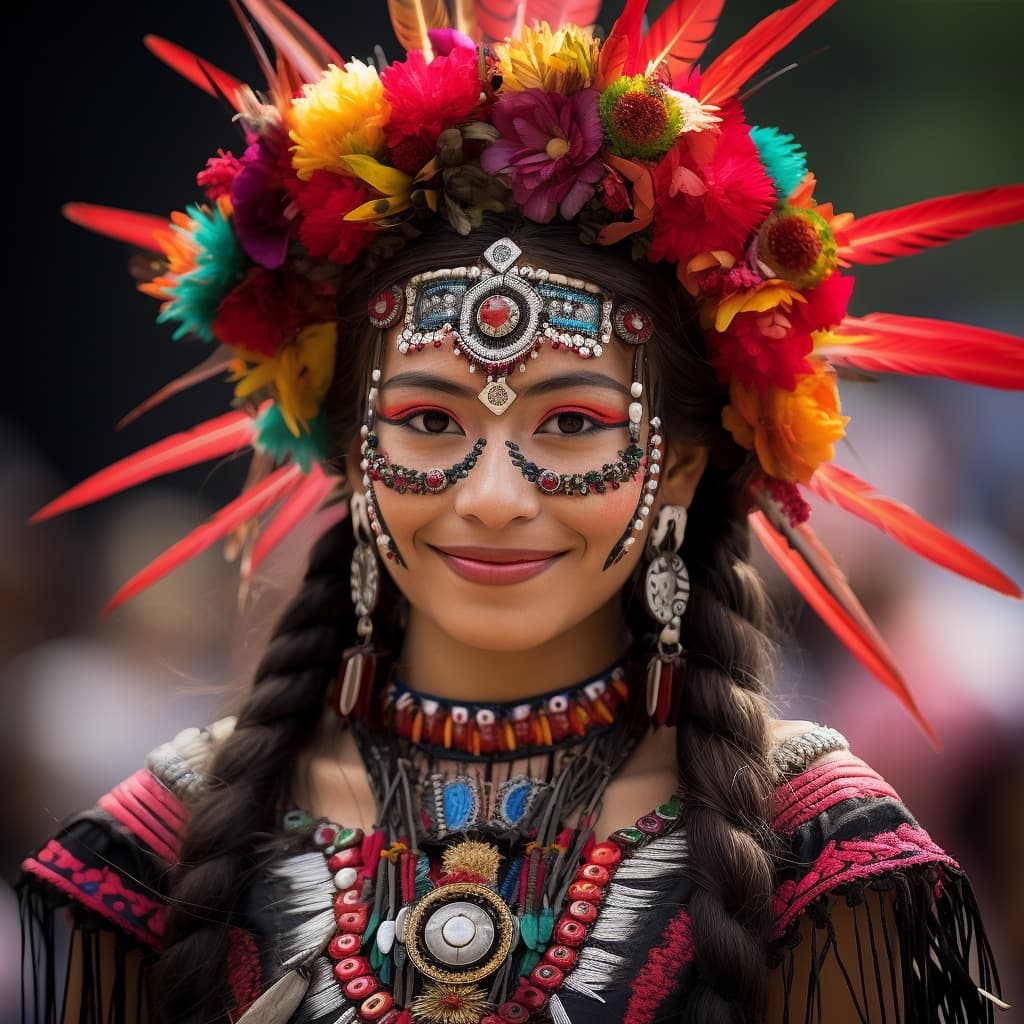
Mixtec Erotic
La Mixteca (Mexico)
Oto-Manguean / Mixtecan / Mixtec
Christianity / Catholicism
Trique, Cuicatecs, Amoltepec
Central America
About Mixtec People
The Mixtec call themselves Ñuu Savi, "People of the Rain," and the name fits a homeland that climbs from the dry valleys of Oaxaca up into pine-forested sierras where weather arrives as drama. La Mixteca spans three Mexican states — Oaxaca, Puebla, and Guerrero — and is conventionally split into the Mixteca Alta (high), Baja (low), and de la Costa (coastal), each with its own dialect, agricultural rhythm, and sense of itself. Linguists count Mixtec not as a single language but as a cluster of dozens, sometimes mutually unintelligible across a single mountain ridge; it belongs to the Oto-Manguean family, one of the oldest documented language stocks in the Americas, alongside Zapotec, Chinantec, and the languages of the closely related Trique and Cuicatec peoples often grouped under the broader Mixtecan umbrella.
Before the Spanish arrived, the Mixtec were one of Mesoamerica's great literate civilizations. Their painted books — the surviving codices like the Nuttall, Bodley, and Vindobonensis — record dynastic genealogies, conquests, and ritual calendars in a pictographic system read in boustrophedon, the eye traveling back and forth across folded deerskin pages. The most famous figure to emerge from those pages is Lord Eight Deer Jaguar Claw, an eleventh-century ruler who unified much of the region and whose biography is the most complete we have for any individual in pre-Columbian America. Mixtec goldwork and lapidary craft were prized across Mesoamerica; the treasures recovered from Tomb 7 at Monte Albán, though the site is Zapotec, were Mixtec work and remain among the finest metalwork ever produced in the hemisphere.
Catholicism arrived with the conquest and settled in, but it settled in on Mixtec terms — saints' days that line up with planting and harvest, mountain shrines older than any church, compadrazgo networks that do the social work parishes elsewhere only pretend to. The tequio, communal labor owed to the village, still organizes everything from road repair to festival logistics in many towns, and guelaguetza-style reciprocal gift exchange threads through weddings and funerals. Migration is the other defining fact of contemporary Mixtec life: large diaspora communities work the agricultural fields of California, Oregon, and Baja California, and a child born in Fresno may grow up speaking a Mixtec variant her grandparents brought from a specific village in the Alta. The language is endangered in some variants and vigorously alive in others, and a generation of Mixtec writers, filmmakers, and linguists is currently doing the work of deciding which.
Typical Mixtec Phenotypes
Reference for AI generation — hair, eyes, skin, facial structure, build
The Mixtec phenotype is shaped by long Indigenous Mesoamerican ancestry concentrated in the rugged highlands of Oaxaca, Puebla, and Guerrero, with relatively limited European admixture compared to mestizo populations of central Mexico. The result is a look that reads as distinctly Mesoamerican: compact, deeply pigmented, and structurally close to the pre-Columbian baseline still visible in Classic-era Ñuiñe and Mixteca-Puebla iconography.
Hair is uniformly black to blue-black, coarse in diameter, and overwhelmingly straight — wave is uncommon and curl is rare. Density is high and the hairline tends to sit low and squared. Body and facial hair are sparse, with light beard growth typical in men. Greying often comes late and stays cool-toned rather than yellowing.
Eyes range from dark brown to near-black, almond-shaped, and frequently carry a soft epicanthic fold — not as pronounced as in East Asian populations but visible in a significant minority, a feature shared across many Mesoamerican Indigenous groups. Light eyes are essentially absent without outside admixture.
Skin tones cluster in Fitzpatrick III–IV, with warm copper, bronze, and olive-bronze undertones; highland Mixtecs trend lighter than Trique and lowland Mixtec speakers, who often sit firmly in IV and tan to a deep reddish-brown under sun exposure. Cheeks frequently carry a natural ruddy flush over the bronze base.
Facial structure is the group's most identifiable signature: broad, high zygomatic cheekbones, a relatively short and wide face, a nose with a moderate-to-low bridge and broader alar base, and full but not everted lips. Jaws are typically squared rather than tapered, and the chin sits short.
Build runs short and stocky — adult male stature often falls in the 1.55–1.65 m range, with women proportionally shorter, among the shortest documented populations in the Americas. Torsos are long relative to limbs, shoulders broad, and body composition tends toward dense muscle and a sturdy lower body. Trique populations are visibly the shortest and most robustly built of the three branches, while Cuicatec phenotype trends slightly taller and finer-boned, and Amoltepec sits between the two.
Data depth
0/100Coverage of image-grounded phenotype observations · drives AI generation diversity
- Sample size
- 0/40· 0 images
- Image quality
- 0/30· 0% high
- Confidence
- 0/20
- Source diversity
- 0/10
- ·No image observations yet
Explore phenotype categories
Structured taxonomy with peer-reviewed scales · 22 anatomical categories






Generate Mixtec AI Content
Use this ethnicity's phenotype data to create AI-generated content with accurate physical traits and cultural context.
Open Creator Studio