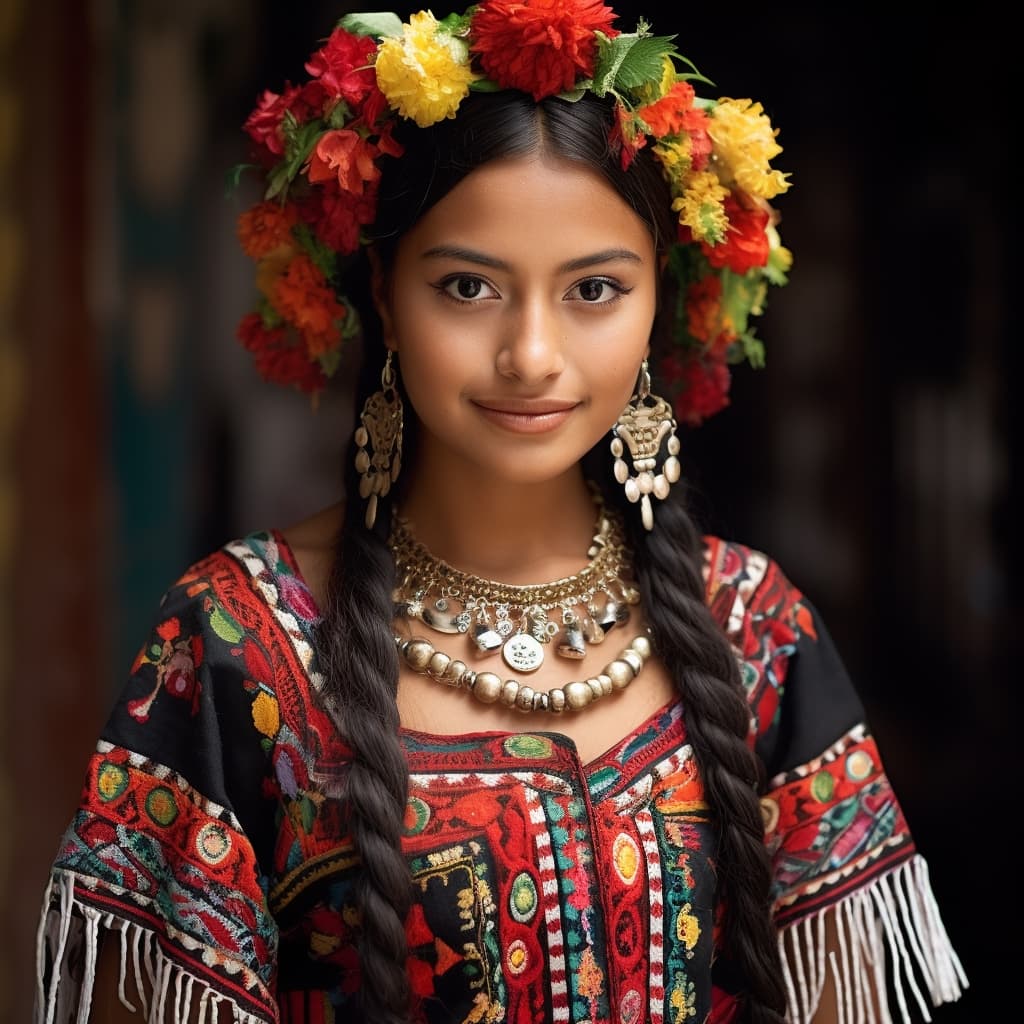
Mixe Erotic
Oaxaca (Mexico)
Mixe–Zoque / Mixe
Christianity / Catholicism
Central America
About Mixe People
The Mixe call themselves Ayuujk jä'äy — "people of the language of the mountain" — and the name fits. Their homeland is the Sierra Mixe, a band of high, fog-soaked ridges in northeastern Oaxaca that drops from cold pine forest at the summits down through cloud forest into hot lowland country in a single day's walk. That vertical geography is the reason the Mixe exist as a distinct people at all: the Aztecs never conquered them, and the Spanish, who arrived in the 1520s, found the upper villages awkward enough to garrison that colonial control sat lightly on the highest communities for centuries. The Mixe still describe themselves, with some pride, as the people who were never defeated.
The language, Ayuujk, belongs to the Mixe–Zoquean family — a small grouping with no living relatives outside southern Mexico, and one that linguists have linked, tentatively but persistently, to the Olmec. It is not mutually intelligible with the Zapotec spoken in the valleys to the south, and even within the Sierra the highland, midland, and lowland varieties shade into separate languages rather than dialects. Tone matters: a syllable's pitch can carry the difference between two unrelated words, which is part of why the older generation's whistled-speech tradition, used to talk across ridges, works at all.
Catholicism arrived with the friars and stayed, but in the Sierra it sits on top of an older religious layer rather than replacing it. Mountains are addressed as persons. Kong Oy, the king-spirit of the peak called Zempoaltépetl, still receives offerings — copal smoke, turkeys, mezcal poured into the earth — at cardinal points around the summit. Most Mixe communities are governed by the sistema de cargos, a ladder of unpaid civic-religious posts that every adult man is expected to climb over his lifetime; refusing the work is a real social sanction, not a formality. Daily decisions in many villages still go through the assembly rather than the party system, and Tlahuitoltepec has become quietly known beyond Oaxaca for its music school, which has turned highland brass bands into one of the most distinctive sounds in southern Mexican music.
Typical Mixe Phenotypes
Reference for AI generation — hair, eyes, skin, facial structure, build
The Mixe — Ayuujk jä'äy, "people of the cloud forest" — are an Indigenous Mesoamerican population concentrated in the Sierra Norte of Oaxaca, and their phenotype reflects deep, relatively unmixed Amerindian ancestry. Compared to mestizo Oaxacan populations, Mixe communities show notably less European admixture, which keeps the typical phenotype tightly clustered around classic Mesoamerican features.
Hair is uniformly black or near-black, straight to slightly wavy, coarse and dense, with strong shine. Premature graying is uncommon; most retain dark hair well into middle age. Body and facial hair are sparse — men typically grow only light mustache and chin growth rather than full beards. Eyes range from dark brown to near-black, almost never lighter. A mild epicanthic fold is common, especially in older women and children, giving the eye an almond shape with a slight upward outer canthus; lashes are straight and dense rather than curled.
Skin tone sits in the Fitzpatrick III–IV range, with warm copper and olive-brown undertones. The high-altitude communities of the Mixe Alta tend slightly lighter than the lowland Mixe Bajo, where sun exposure deepens the tone toward bronze. Cheeks often carry a subtle ruddy flush from cold mountain air at elevation.
Facial structure is broad and strongly modeled: wide zygomatic arches, prominent malar cheekbones, a relatively short midface, and a nose with a low-to-medium bridge and moderately wide alar base. Lips are medium-full, well-defined, with a clear vermilion border. Jaws are square in men, softer and rounder in women, and chins tend to be modest rather than projecting.
Build runs short and compactly muscular. Mixe adults are among the shorter populations documented anthropometrically in Mexico — men typically 1.55–1.65 m, women 1.45–1.55 m — with broad shoulders relative to stature, sturdy thighs from mountain agriculture, and a tendency toward central rather than peripheral fat distribution. The overall silhouette reads grounded and powerful rather than slender, especially in women who carry through pregnancy and field labor.
Data depth
0/100Coverage of image-grounded phenotype observations · drives AI generation diversity
- Sample size
- 0/40· 0 images
- Image quality
- 0/30· 0% high
- Confidence
- 0/20
- Source diversity
- 0/10
- ·No image observations yet
Explore phenotype categories
Structured taxonomy with peer-reviewed scales · 22 anatomical categories
Notable Mixe People
1 reference figure — sourced from Wikipedia
- Sandra Domínguez — 1987–2024), human rights activist






Generate Mixe AI Content
Use this ethnicity's phenotype data to create AI-generated content with accurate physical traits and cultural context.
Open Creator Studio