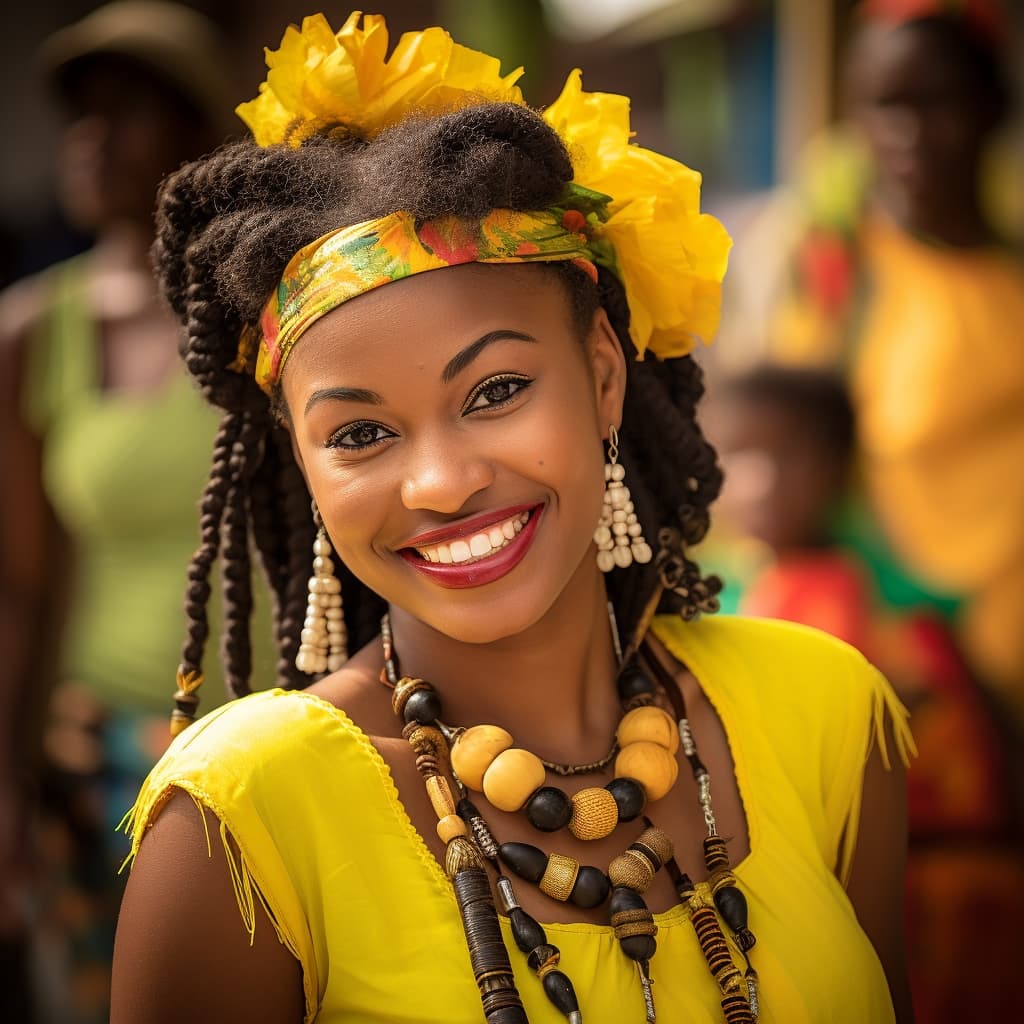
Garifuna Erotic
Saint Vincent and the Grenadines
Arawakan / Ta-Arawakan / Garifuna
Christianity / Catholicism
Central America
About Garifuna People
The Garifuna are the descendants of West and Central African people — many shipwrecked or escaped from slave ships in the 17th century — who intermarried with the indigenous Island Carib and Arawak population of Saint Vincent. The result is a people who are genealogically African and culturally Amerindian in their bones: the language, the cosmology, and the kinship structures came from the Carib world, while the music, the spirit-work, and a great deal of the cuisine carry unmistakable African signatures. They sometimes call themselves Garinagu in the plural, and the older colonial term "Black Carib" still appears in historical sources.
Their language is a striking thing. Garifuna belongs to the Arawakan family, which makes it linguistically Amerindian rather than African or European, and it preserves an unusual feature once common in the Caribbean: a partially gendered vocabulary in which men and women historically used different words for certain everyday concepts — a residue of the Carib conquest of an earlier Arawak-speaking population. The language also carries layers of Kallínago, French, English, and Spanish loanwords, charting the people's contact history fairly precisely.
The defining historical rupture came in 1797, when the British, after losing patience with Garifuna resistance on Saint Vincent, deported the survivors to the island of Roatán off the coast of Honduras. From there they spread along the Caribbean coast of Central America, and today the population is concentrated in Honduras, Belize, Guatemala, and Nicaragua rather than on the original homeland. Saint Vincent retains only a small Garifuna community; the cultural center of gravity has been the mainland for more than two centuries.
Religion is officially Catholic almost across the board, but the more interesting layer underneath is dügü, an ancestor-honoring ceremony in which the living are summoned to feed and reconcile with their dead. It involves drumming, possession, and days of communal cooking, and most Garifuna families participate in some form of it without seeing any contradiction with the church. Punta, the most recognizable Garifuna music and dance, grew out of this ceremonial world before becoming a popular secular form across Central America. Cassava bread — ereba, made from bitter cassava processed through a long woven press called a ruguma — remains the staple that anchors the cuisine and, by extension, the household economy in coastal villages. UNESCO recognized Garifuna language, dance, and music as a Masterpiece of the Oral and Intangible Heritage of Humanity in 2001.
Typical Garifuna Phenotypes
Reference for AI generation — hair, eyes, skin, facial structure, build
The Garifuna phenotype reflects their distinct ethnogenesis — descendants of West and Central African Maroons who intermarried with Island Carib (Kalinago) and Arawak populations on Saint Vincent before their 1797 exile to Roatán and the Central American coast. The result is a population that reads as predominantly Afro-descended but carries a consistent Indigenous American substrate that distinguishes them visually from neighboring Afro-Caribbean groups.
Hair runs heavily toward Type 4 coily textures — tight coils, dense, often kept short or in protective styles — though Type 3 curl patterns and looser waves appear with notable frequency, particularly along the female line where Indigenous admixture tends to be highest. Color is near-uniformly black or very dark brown; sun-lightening at the tips is common in coastal communities. Eyes are most often deep brown to near-black, with hazel and lighter brown showing up in a meaningful minority. The eye shape frequently carries a slight almond cast inherited from the Carib-Arawak side; epicanthic folds are not standard but a softened inner-corner contour is more common than in unmixed West African populations.
Skin tones span Fitzpatrick IV through VI, clustering in the V–VI range — warm brown to deep brown with red or olive undertones rather than the cooler blue-black undertones common in some West African groups. Facial structure tends toward broader noses with rounded tips and moderately wide alar bases, full lips, and high, somewhat flatter cheekbones — the cheekbone architecture being the clearest visible Indigenous contribution. Jawlines are typically rounded rather than angular.
Build is generally medium-statured — men commonly 5'7"–5'10", women 5'2"–5'5" — with sturdy, athletic compositions shaped by generations of fishing and coastal subsistence work. Hips and shoulders read proportionate; the very tall, lean frames associated with some East African populations are uncommon. The signature combination is dark Afro-textured hair and deep skin paired with subtly Amerindian facial geometry — that pairing, more than any single feature, is what makes the Garifuna phenotype legible.
Data depth
0/100Coverage of image-grounded phenotype observations · drives AI generation diversity
- Sample size
- 0/40· 0 images
- Image quality
- 0/30· 0% high
- Confidence
- 0/20
- Source diversity
- 0/10
- ·No image observations yet
Explore phenotype categories
Structured taxonomy with peer-reviewed scales · 22 anatomical categories
Notable Garifuna People
5 reference figures — sourced from Wikipedia
- Breton, Raymond — 1877) [1635]. Grammaire caraibe, composée par le p. Raymond Breton, suivie du…
- OCLC — Flores, Barbara A.T. (2001) Religious education and theological praxis in a c…
- University of Illinois Press — Gonzalez, Nancie L. Solien (1988). The Sojourners of the Caribbean: Ethnogene…
- McClaurin, Irma — . Women of Belize: Gender and Change in Central America. 1996. New Brunswick:…
- Bergin & Garvey — Sutherland, Anne (1998). The Making of Belize: Globalization in the Margins. …






Generate Garifuna AI Content
Use this ethnicity's phenotype data to create AI-generated content with accurate physical traits and cultural context.
Open Creator Studio